Automatic SEO: what actually automates, and what does not
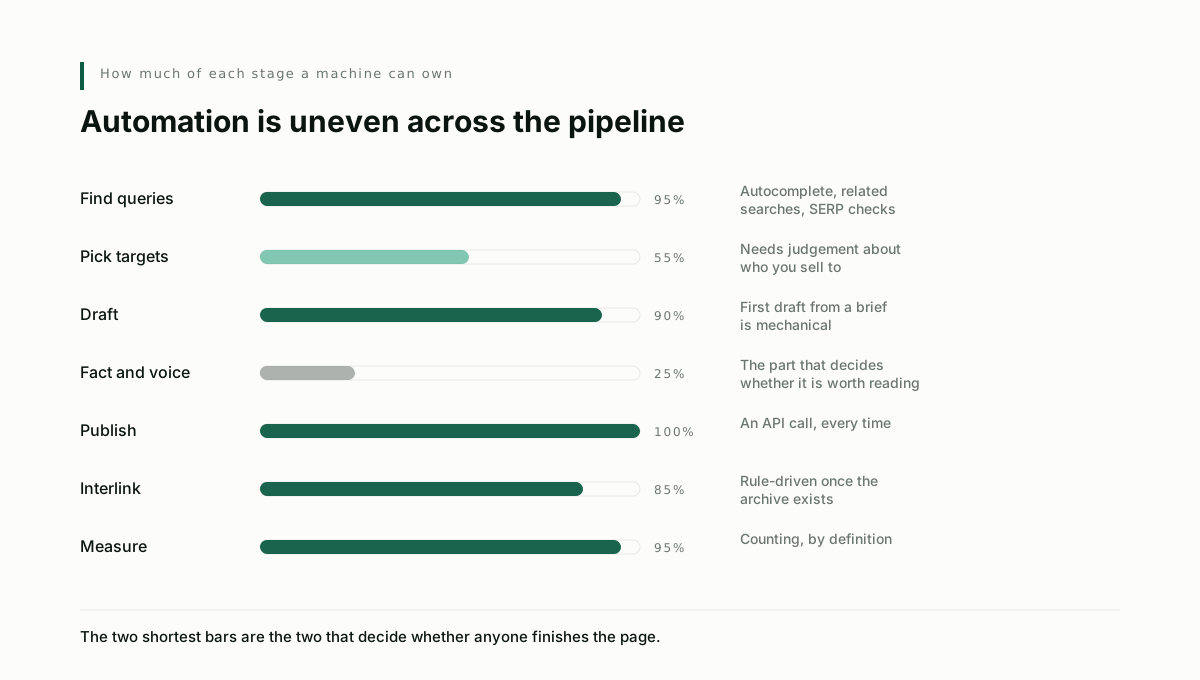
"Automatic SEO" is sold as one thing and is actually seven, and they do not automate equally well. Some stages a machine does better than you will. Two of them it cannot do at all, and those two decide whether any of the rest was worth running.
The stages that automate cleanly
Finding what people search. Google gives this away. Autocomplete, People Also Ask, and related searches are all machine-readable, and they come from real queries rather than from a model's guess about them. A script can expand three seed terms into two hundred real phrases in a couple of minutes.
Checking who ranks. One request per query against a live results page tells you the positions. Tedious by hand, trivial in a loop.
Producing a first draft. Given a brief, an outline, and the facts, a draft is mechanical work. This is the stage everyone means when they say AI content, and it is genuinely solved.
Publishing. An API call. The reason it feels unsolved is covered below.
Internal linking. Once you have an archive, deciding which page should link to which is a similarity calculation with a few rules on top.
Measuring. Counting, by definition.
The two that do not
Deciding which queries are worth your time. A tool can tell you that 400 people a month search a phrase and that a competitor ranks third for it. It cannot tell you that those 400 people are students who will never pay you, while a different phrase with 20 searches is typed exclusively by buyers. That judgement needs to know who you sell to and what they are worth, and no amount of SERP data contains it.
Being right, and sounding like someone. A draft that is confidently wrong about a price, a date, or how your own product works costs more than no article. So does forty articles that read identically.
This is also where the policy line sits. Google's spam policies do not ban AI-written content. They describe scaled content abuse as generating many pages "for the primary purpose of manipulating search rankings and not helping users", and note it applies "no matter how it's created". The policy is about whether the page was worth publishing, not about which tool typed it.
What this means in practice
| Stage | Automate it | Why |
|---|---|---|
| Expand seed terms | Yes | Google's own suggestion surfaces are the source |
| Check rankings | Yes | One request per query, no judgement involved |
| Choose targets | No | Needs to know who your buyers are |
| Write first draft | Yes | Mechanical given a good brief |
| Verify facts | No | Wrong beats absent, and only you can tell |
| Set the voice | Partly | A style guide helps; taste does not transfer |
| Publish | Yes | An API call |
| Internal links | Yes | Rules plus similarity |
| Track results | Yes | Counting |
A tool that claims the whole column is a yes is either not doing the two hard stages or is doing them badly and not telling you.
The stage everyone skips
Publishing is the easiest step to automate and the one most often left half-built, because generating articles demos well and publishing is plumbing: credentials, a CMS that rejects your post without saying why, image uploads, slug collisions.
We found this in our own data. One of our sites had thirty generated articles and six published.
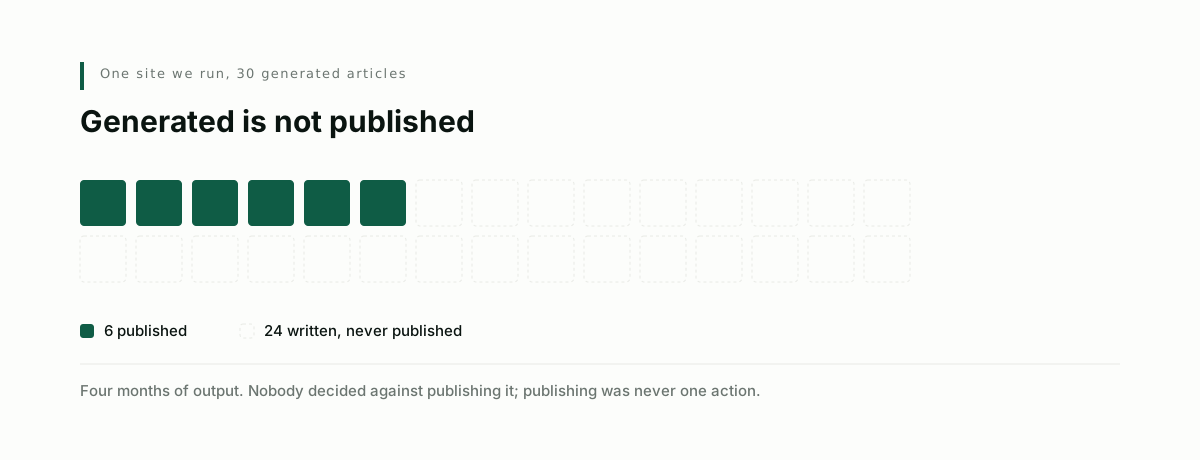
Twenty-four finished articles, written across four months, sitting in draft. Nobody had decided against publishing them. The dashboard had a publish button on each article's own page, so putting them live meant twenty-four visits and twenty-four clicks, and that is not a task anyone starts on a Tuesday.
It also made three unrelated features look broken. Internal linking had six pages to work with instead of thirty and placed almost nothing. Competitive gap analysis compared six pages against a competitor's several hundred. AI visibility scored near zero, because an unpublished page cannot be cited for the same reason it cannot rank.
What the data stages cost
The research half of automatic SEO comes down to how many live result pages you can afford to check, and providers differ by more than most people expect.
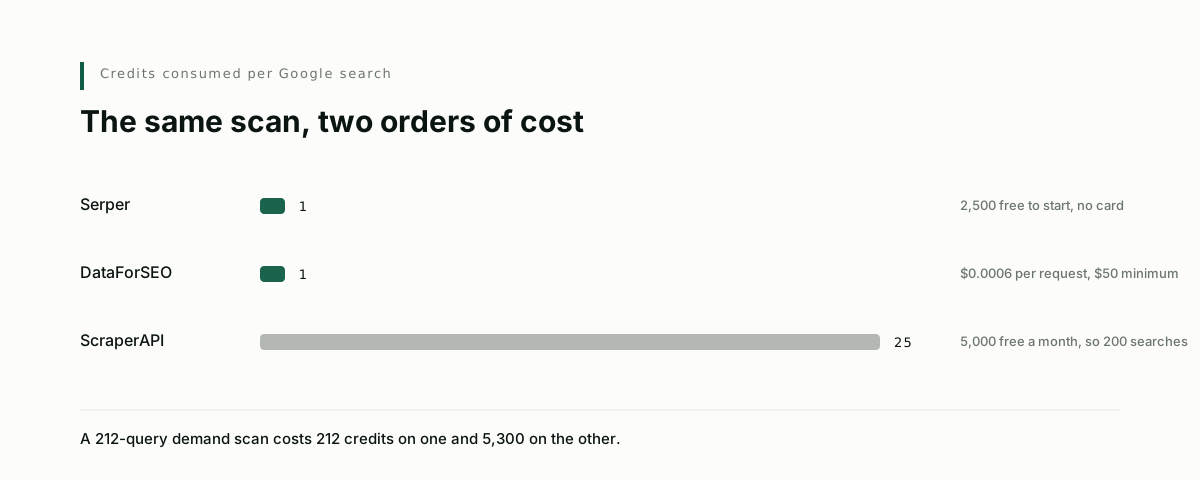
We ran a scan that expanded to 212 real queries. On a provider charging 25 credits per search, that is 5,300 credits against a free tier of 5,000, so the free plan cannot complete a single scan. On a provider charging one credit, the same scan costs 212.
This is worth checking before you commit to a tool, because it decides whether "check the whole keyword set" is a thing you do monthly or a thing you do once and then avoid.
A reasonable setup
Automate the expansion, the ranking checks, the drafting, the publishing, the linking, and the measurement. Keep two things on your desk: which queries you chase, and whether the draft is true and sounds like you.
That division is not a compromise while the technology catches up. The two manual stages are manual because they depend on knowing your business, and that is not an input any tool has.
Visorank runs the automatable stages and shows you observed data rather than estimates for the stages where you decide.