Half of dental SEO is not something you can write your way into
Someone with toothache searches, sees three practices on a map, and calls one. No article you publish changes that ranking. What content changes is everything that happens before the toothache: the patient reading about implant costs for a fortnight, comparing, and arriving at a decision about where to go.
Why most dental content never earns a patient
Open the blog of almost any practice and you find the same four posts. Why you should floss. Five tips for a brighter smile. We are excited to welcome Dr Someone. Our new chairs have arrived. None of it is wrong. None of it was ever searched for by a person who had not already chosen the practice.
Meanwhile the queries that carry an actual decision sit unanswered. What a crown costs and why the quotes vary so much. Whether a root canal or an extraction is the better call at a given age. How long an implant takes from first appointment to final tooth. What happens if you do nothing. Those searches come from people who have not picked a practice yet, and in most towns nobody local has written a serious answer to any of them.
The practices that do answer them tend to do it once, by accident, and then stop, because writing a careful 1,400-word piece about implant timelines is an evening's work for a clinician whose evenings are not free.
What Visorank does for a practice
It handles the research, the draft and the publishing. It does not handle the part that has to come from a clinician, and the section after this explains why that boundary is not negotiable in health content.
- Finds the questions patients actually type
- Expands your terms using Google's autocomplete, related searches and People Also Ask, so the list is what people search rather than what reads well in a brochure. Cost, duration, pain, alternatives and 'what if I wait' dominate it every time.
- Writes the draft with the answer up front
- A direct answer in the opening paragraph, then the detail. This is the structure Google's featured snippets lift and the structure an AI assistant quotes from, and it is the opposite of the long warm-up most practice blogs open with.
- Leaves the clinical review to you
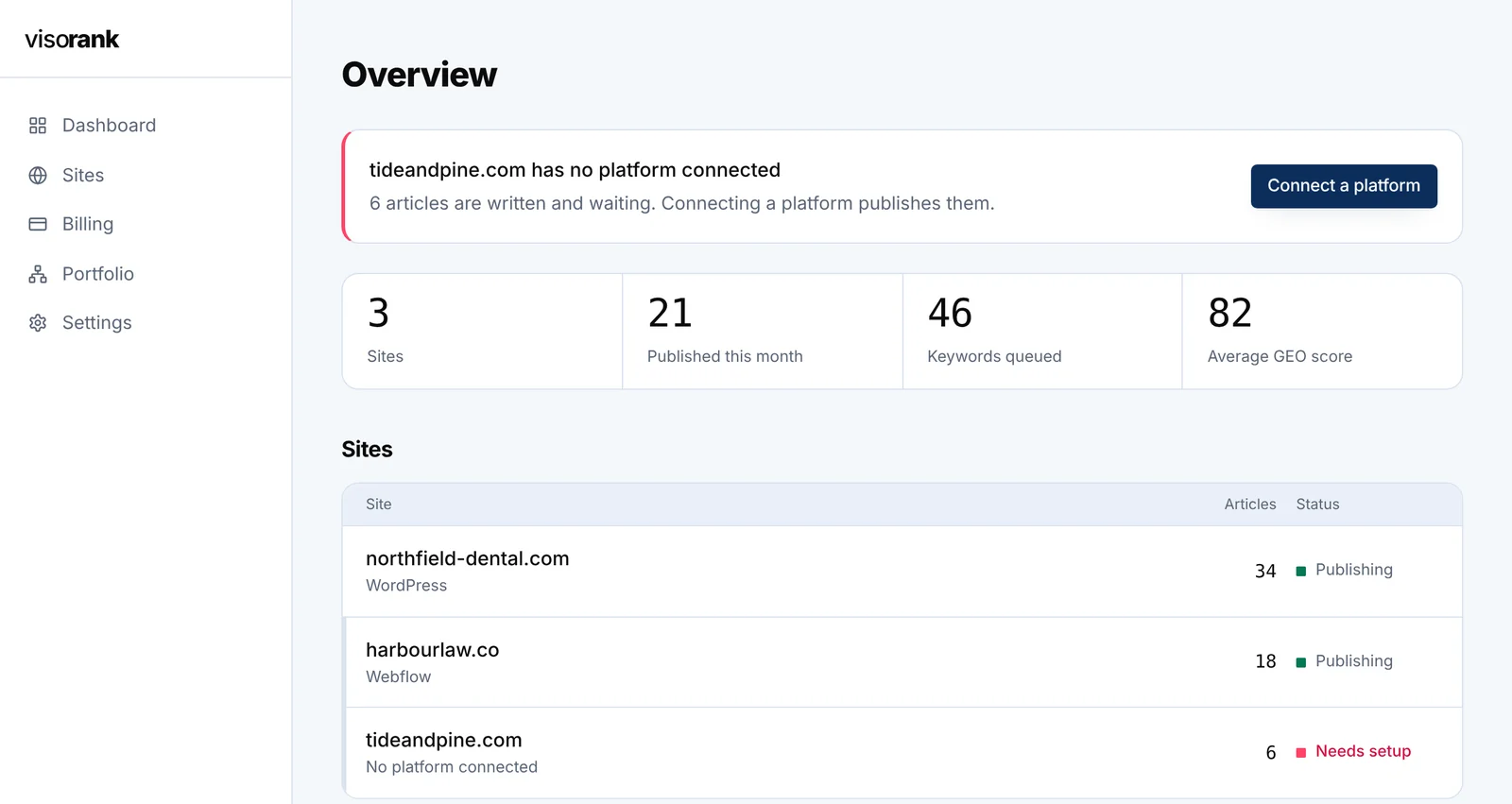
- Every draft arrives unpublished. You read it, correct it, and attach your name. Nothing goes live on a schedule you have not approved.
- Publishes and files it properly
- Posts to WordPress or your own endpoint under the right category, so implant content accumulates in one place instead of scattering through an undated feed.
- Audits the site you already have
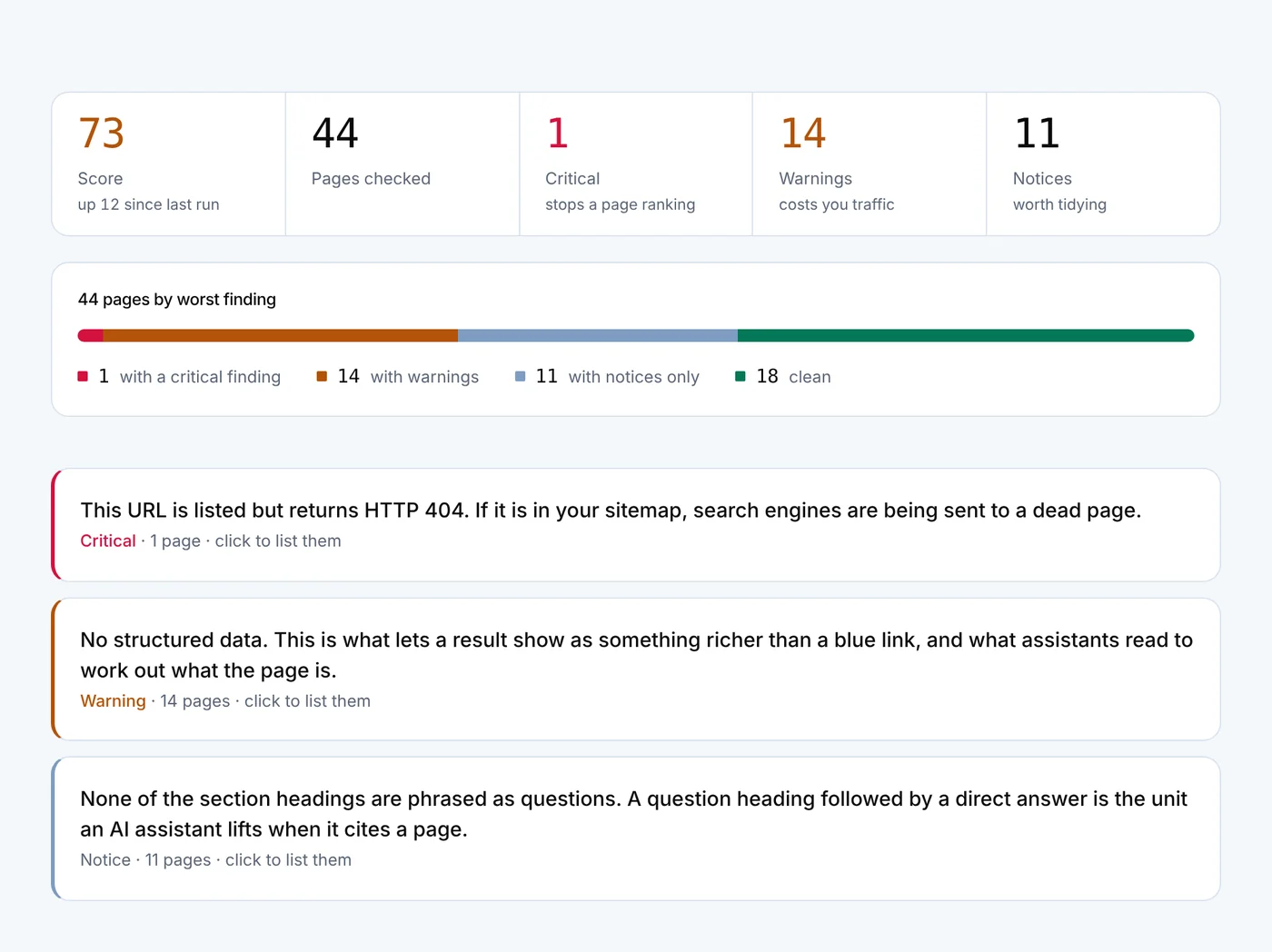
- Crawls what is published and reports what is broken: missing titles, pages blocked from indexing, duplicate content, no structured data. On most practice sites built by a web designer rather than an SEO, this finds more than the content does.
Run the free audit on your practice site and see what is already costing you visibility.
Start freeWhy health content is held to a different standard
Google's published guidelines for the people who assess search quality single out topics that can affect a person's health, finances or safety, and instruct raters to apply a higher bar to them. Dental content sits squarely inside that. The practical effect is that an anonymous article about root canal recovery competes badly against the same article with a named, registered clinician behind it, and that a site of unattributed health posts can plateau regardless of how well written it is.
This is the reason the drafts here are drafts. Software can research a topic and write a clear explanation of it. It cannot be the dentist who stands behind the explanation, and in this category that authorship is not a formality, it is most of the ranking argument.
What works in practice: one named clinician reviews each piece, their name and registration appear on it with a short line about their actual experience, and the page says when it was last reviewed. That takes a practice fifteen minutes per article instead of an evening, and it is the fifteen minutes the whole thing depends on.
What you are allowed to claim is not a style question
Dental advertising is regulated, and the rules are set where you practise rather than by a general principle. Superlatives, guarantees about outcomes, before-and-after imagery, patient testimonials and the word specialist are all restricted in some jurisdictions and permitted in others. In the United States the relevant authority is your state dental board, with the ADA's advertising guidance behind it. In the UK it is the General Dental Council's standards plus the advertising codes. Australia, Canada and the EU each have their own.
No tool can resolve this for you, and any tool that claims to has not read the rules. What Visorank does is keep the generated copy away from the categories that cause trouble: it does not write guarantees of outcome, it does not write comparative superlatives about your practice, and it does not fabricate patient quotes. The remaining judgement, which is whether a given sentence is permissible where you practise, is yours and is part of the review.
The upside is that the restriction pushes you towards the content that works anyway. A page that cannot promise the best implants in the city has to explain how implants actually work instead, and the explanation is the thing people search for.
The map pack is a separate job, and content barely touches it
For a search with local intent, the three map results above the normal listings take the large majority of the clicks, and what decides who appears there is mostly not your website. It is your Google Business Profile: the categories you have selected, the proximity of the searcher, your review count and recency, how complete the profile is, and the consistency of your name, address and phone number across the web.
That work is worth doing first and it is worth doing by hand. It is a few hours, it is free, and no amount of publishing substitutes for it. Visorank does not manage your Business Profile and does not pretend the two problems are one problem.
Where content does change the local picture is indirect. Pages that answer real questions get linked to and cited, which strengthens the site overall, and a site that is genuinely the best local answer on a subject tends to be the one that shows up when the search is informational rather than immediate. The split to hold in your head: the map pack wins you the patient who already has a problem today. Content wins you the patient who will have one in three months and is reading now.
What this will not do for a practice
It will not get you into the map pack. That is Business Profile work, reviews and proximity, and it is the higher priority of the two if you have not done it.
It will not supply clinical authority. The drafts need a named clinician's review before they are worth publishing, and in health content that review is the part that makes the page competitive rather than a box to tick.
It will not tell you what you may legally claim where you practise. It avoids the obvious hazards and leaves the judgement with you.
It will not produce patients in a month. Content published now is read in three to six. A practice that needs appointments next week needs ads or the phone, not an article.
Start with one treatment, three articles, and your own name on them.
Start freeQuestions worth asking first
Will Google penalise a dental site for AI-assisted content?
Google's stated position is that it rewards helpful, reliable content regardless of how it was produced, and acts against content produced primarily to manipulate rankings. The distinction that matters for a practice is authorship: an unattributed health article is weak whoever or whatever wrote it, and the same article reviewed and signed by a registered clinician is not. The review is the thing to get right.
How many articles does a practice actually need?
Fewer than most tools imply. A practice offering five or six treatments has maybe thirty genuine questions patients ask before booking, and thirty thorough pages that each own a question outperform two hundred thin ones. The duplicate guard stops the generator producing near-identical pages once the real questions run out, which is a feature rather than a limitation.
Can it write about treatments we do not offer?
It will if you give it those keywords, which is usually a mistake. A page that ranks for a treatment you do not provide brings in enquiries you have to turn away, and turns your site into a referral service for competitors. Keep the keyword list to what you actually do.
Does it add structured data for a dental practice?
It adds article and FAQ structured data to the pages it publishes. The practice-level markup that describes your business, its address, opening hours and services belongs on your site's templates rather than in individual posts, and the audit flags when it is missing.