Most firms' SEO problem is that they built the same page forty times
Personal injury lawyer Dallas. Personal injury lawyer Plano. Personal injury lawyer Irving. Forty pages, one paragraph of difference between any two, and Google treating the whole set as one weak page. It is the commonest structure in legal marketing and it is the reason so many firms publish constantly and rank nowhere.
Why the standard legal page set stops working
The practice-area-by-location grid is appealing because it is easy to generate and because it maps onto how a firm thinks about its market. The difficulty is that it maps onto nothing a searcher experiences. Someone looking for a lawyer in a metro area does not care which suburb page they land on, and search engines, which have been consolidating near-duplicate pages for over a decade, treat the grid as what it is: one page repeated with the place name changed.
The outcome is predictable. None of the forty pages accumulates enough signal to rank, they split the links the firm does earn between them, and the firm concludes that SEO does not work for law.
The other failure is subtler. Legal content tends to be written to demonstrate competence rather than to answer anything. A page headed Our Personal Injury Practice establishes that the firm has one. It does not answer how long someone has to file, what happens at a first hearing, whether a given claim is worth pursuing, or what any of it costs, which is what the person reading at eleven at night actually wants to know.
What Visorank does for a firm
It builds the content layer: the pages that answer the questions a prospective client asks before they are willing to phone anyone. It leaves the attorney review, which in this category is not optional, with the firm.
- Finds the questions, not the job titles
- Expands your terms with Google's autocomplete, related searches and People Also Ask. For legal queries this surfaces procedure, timing, cost and eligibility questions, which is where the volume and the intent both are.
- Stops the duplicate grid before you build it
- When the generator produces pages that differ only by a place name, it halts after three consecutive near-duplicates rather than filling your site with the structure that causes the problem.
- Writes the answer first
- The direct answer goes in the opening paragraph, before the context. This is the format featured snippets lift and the format an AI assistant quotes, and it is the opposite of the two-paragraph preamble most legal writing opens with.
- Keeps everything in draft
- Nothing publishes without you. Given what is at stake in legal content, the review step is the point rather than an inconvenience.
- Audits what is already live
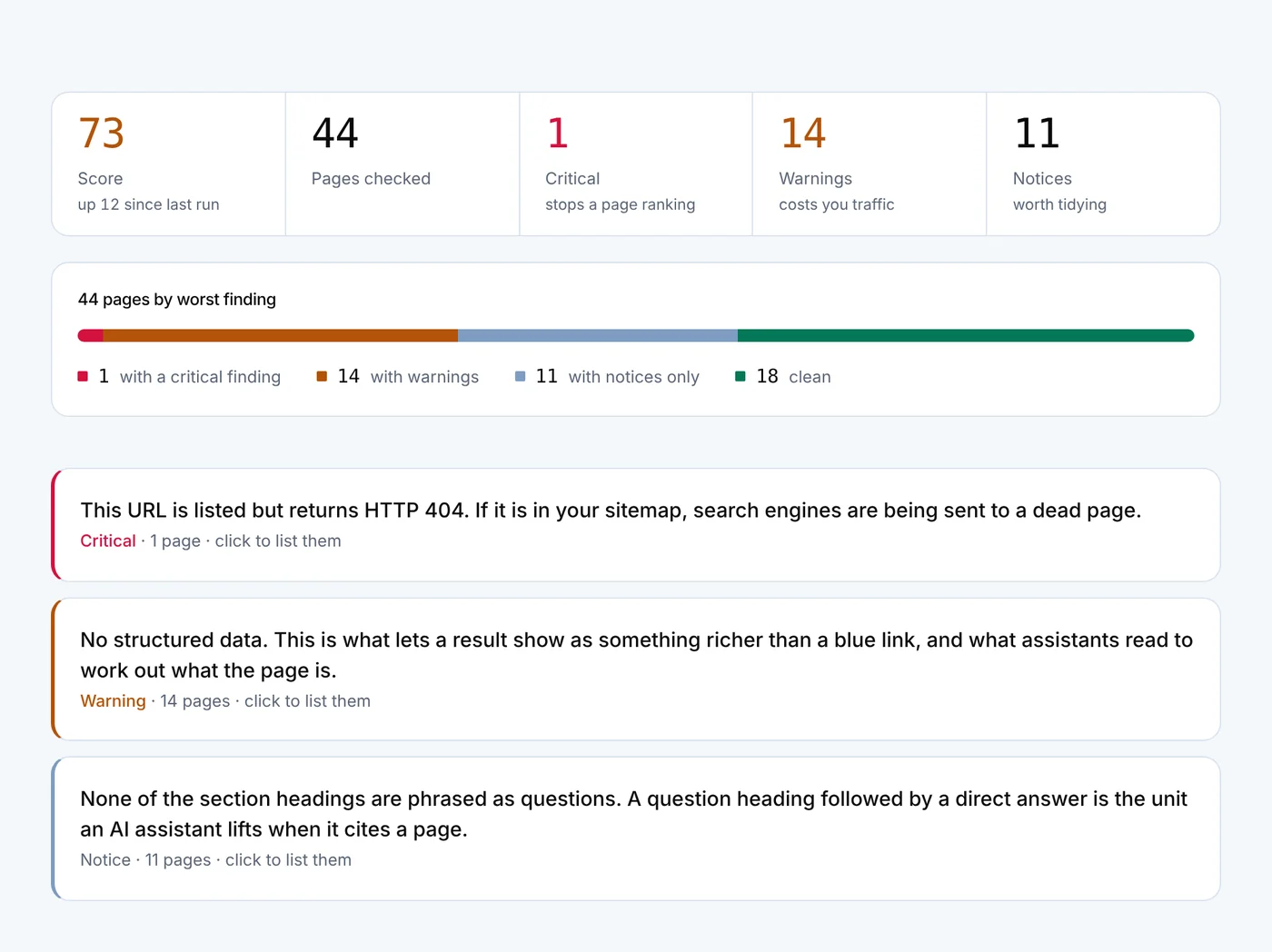
- Crawls the site and reports duplicate content, missing titles, pages excluded from indexing and absent structured data. On a firm site that has accumulated pages over a decade, this is usually where the first real gains are.
Run the free audit and see how much of your site is competing with itself.
Start freeThe structure that works instead of the grid
One substantial page per practice area, written to be the best available explanation of that area of law for a non-lawyer. One page per office location, about the office: the people in it, the courts it appears in, how to get there, what happens when you walk in. Then a question layer underneath, one page per real question, which is where the volume lives and where the firm can genuinely outwrite competitors.
The question layer is the part almost nobody builds properly, and it is the part that compounds. How long do I have to file a claim in my state. What does a free consultation actually involve. Will my case go to trial. What happens if the other side will not settle. How are fees calculated, and what comes out of a settlement before I see it. Each of those is a page, each has steady search volume, and each is read by someone closer to hiring a lawyer than any visitor to a practice-area overview.
This structure is also more defensible against the duplication problem, because the pages differ in substance rather than in place name. A page about filing deadlines in one state genuinely differs from the same page about another state, since the deadline differs.
Where advertising rules bind, and they do
Lawyer advertising is regulated by jurisdiction and the rules have teeth. Across the United States, state bar rules descended from the ABA model prohibit false or misleading communications about a lawyer's services, restrict claims of being a specialist or expert unless the lawyer holds the relevant certification, and in many states require disclaimers alongside testimonials or any description of past results. Several states require advertising to be retained for a period, and some require submission for review. In England and Wales the Solicitors Regulation Authority additionally requires firms to publish price and service information for certain work.
Content is advertising for this purpose. An article on your firm's site describing outcomes you have obtained is subject to the same rules as a billboard, and the fact that a tool produced the first draft changes nothing about who is responsible for it.
Visorank's generated copy stays away from the obvious categories: no claims about being the best or the leading firm, no guarantees or predictions of outcome, no invented client testimonials, no past-results figures. What it cannot do is tell you what your jurisdiction requires, because that varies and a page stating one state's rule as general would be its own kind of misleading. That judgement stays with whoever at the firm signs off on marketing, and the review step exists for it.
Why legal content is slow, and why that is an advantage
Legal queries sit in the category Google's rater guidelines treat with extra scrutiny, since the advice affects people's finances and liberty. Expect a longer run-up than in an unregulated niche: months rather than weeks before a new page settles, and a meaningful penalty on anonymous content. Author attribution to a named, admitted lawyer with a real biography is worth more here than almost anything else you can do to a page.
The consideration cycle works the same way. Nobody reads one article and retains counsel. They read for a week, often across several firms, and the firm that answered the most of their questions clearly is the one they call. This makes legal content unusually hard to attribute and unusually valuable once it works, because a single matter is worth more than a year of the tooling.
It also means volume is the wrong target. Thirty thorough pages that each own a question beat three hundred that each own nothing, and in a regulated category the three hundred carry three hundred compliance risks.
What this will not do for a firm
It will not give legal advice, and nothing it drafts should be published as if it did. The drafts explain procedure in general terms, and a lawyer has to check that the explanation is right for the jurisdictions you practise in.
It will not tell you whether a sentence complies with your bar's advertising rules. It avoids the obvious hazards. The sign-off is yours.
It will not build the practice-area-by-city grid, which is deliberate. If that is the strategy you want, this is the wrong tool.
It will not produce a signed client this quarter. Legal content runs on a six to twelve month horizon. A firm that needs matters now needs referrals or paid search.
Pick one practice area, ten real client questions, and an attorney to sign off.
Start freeQuestions worth asking first
Is AI-assisted content a problem for a law firm site?
The ranking question and the ethics question are separate and both matter. On ranking, Google rewards useful content regardless of how it was produced and acts against content made to manipulate rankings, so the issue is quality and authorship rather than the tool. On ethics, you remain responsible for every statement published under the firm's name, which means an attorney has to read it. A draft nobody checked is the actual risk, not the drafting method.
Should we write location pages at all?
One per office you genuinely occupy, written about that office. Not one per suburb you would like clients from. The test is whether the page would still make sense to a person standing outside the building. If there is no building, there is no page.
What ranks faster, practice area pages or question pages?
Question pages, usually by a wide margin. Practice-area terms are the most competitive in legal search and are contested by firms with large budgets and long-established sites. A question like what happens at a first custody hearing has lower volume, far less competition, and is read by someone much closer to hiring.
Can it write about law in multiple jurisdictions?
It can draft per jurisdiction, and this is the one place where a page set that varies by location is legitimate, because the underlying rules genuinely differ. It is also the place where review matters most, since a deadline stated for the wrong state is worse than no page.