Before you blame AI Overviews, rule out the other four things
AI search has taken clicks from informational queries and that is real. It is also the most available explanation for any decline, which makes it the one people reach for when the actual cause is a technical problem they could have fixed in an afternoon.
Four causes that look identical in a traffic chart
A decline in organic clicks has several possible causes and they produce the same shaped graph. Distinguishing them takes an hour and determines whether you spend the next quarter rewriting content or fixing a configuration error.
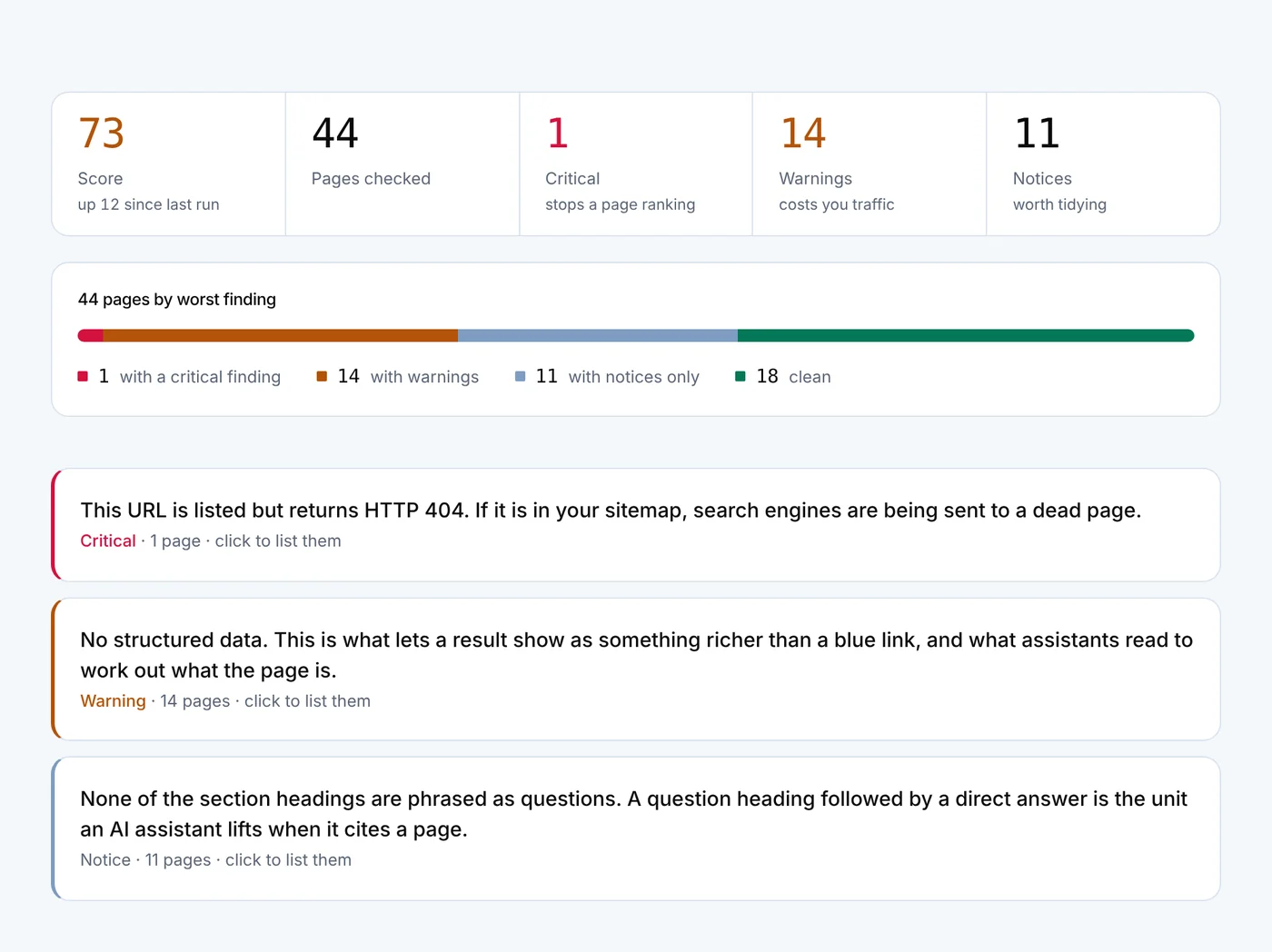
A technical problem is the first to rule out because it is the cheapest to fix and the most often missed. Pages that fell out of the index, a canonical pointing somewhere wrong, a noindex left in from a redesign, a robots.txt line from staging. These produce steep declines that look like an algorithm.
An ordinary ranking loss is the second. Positions slipped because a competitor improved or the algorithm updated. This shows up as impressions falling alongside clicks, which is the distinguishing mark.
Seasonality is the third and is embarrassing when missed. Compare with the same period last year rather than last month.
AI Overviews are the fourth, and they have a signature that none of the others share.
How to tell them apart
Search Console answers most of this, and the order below is cheapest first.
- Run a site audit first
- Indexing problems, noindex tags, canonical conflicts and duplicate content. This takes minutes and rules out the cheapest cause. The audit here is free.
- Compare impressions against clicks
- The key diagnostic. Impressions steady with clicks falling points at something between the result and the visit, which is the AI Overview signature. Both falling together is a ranking loss.
- Split by query type
- Informational queries losing while commercial and navigational queries hold is the overview pattern. A decline spread evenly across all types is not.
- Compare year on year
- Not month on month. Seasonality accounts for more unexplained declines than anything in this list.
- Check your positions directly
- If average position held while clicks fell, you did not lose rankings. You lost the click.
Run the free audit before concluding anything about AI search.
Start freeWhat to do about the part that is genuinely AI search
Once the other causes are ruled out and the pattern is real, there are three responses and only two are useful.
Shift what you target. Questions with a short factual answer are worth less than they were, because an overview can answer them completely. Decisions, comparisons, tasks and anything requiring your specific knowledge are worth roughly what they were, because the overview cannot complete them. This is a keyword decision rather than a writing one and it is the response with the largest effect.
Compete to be the cited source. If the overview is going to answer the question, being named in it is the remaining visibility, and that is structural work: the answer up front, question headings, adjacency, checkable specifics. The free checker measures all of it.
The third response is blocking AI crawlers, which removes you from the answers and from any traffic they would have sent. Some publishers with large archives and licensing leverage make that trade deliberately. For most small sites it trades a small loss for a total one.
The four things the scorer measures, and why those four
An assistant answering a question does not read your page the way a person does. It is looking for a passage it can lift and attribute. Four properties decide whether your page contains such a passage, and all four are structural rather than stylistic, which is why they can be measured rather than judged.
A direct answer in the opening. If the first paragraph restates the question, sets context and promises an answer later, there is nothing to lift from it. The answer has to be in the first hundred words or so, stated plainly, before the caveats.
Headings phrased as questions. An assistant matching a user's question against your page matches most readily against a heading that is itself that question. Our own audit of langoli.com found thirty-three pages with not one question-phrased heading on them, which is typical rather than unusual.
Answers sitting directly under their questions. A question heading followed by two paragraphs of preamble breaks the pairing. The answer has to be the first thing under the heading, which is a formatting discipline more than a writing one.
Specific facts a reader could check. Numbers, dates, named entities, concrete claims. A page of general advice has nothing to quote; a page stating that the llms.txt v2 spec is dated 10 August 2026 does. This is the signal that filler content fails hardest: scoring a filler article on this dimension took its score from 74 to 45 once the measure was corrected.
What this cannot tell you
Exactly how much traffic AI search cost you. Google does not report overview impressions separately, so every published figure is an estimate from sampled data and they disagree with each other substantially.
Whether you appear in overviews. Measuring that means checking queries by hand or buying a tracking product.
That the structural work recovers the clicks. If an overview answers the question completely, a citation earns a mention rather than a visit.
Anything about queries with too little data in Search Console, which on a small site is most of them.
Impressions steady, clicks down. That is the diagnostic worth learning.
Start freeQuestions worth asking first
Impressions are up but clicks are down. What does that mean?
That you are still being shown and less often visited. That is the signature of something sitting between the result and the click: an overview, a featured snippet answering fully, or a results page that got busier. It is specifically not a ranking loss, and treating it as one sends you rewriting pages that are ranking fine.
Should I stop publishing informational content?
No, but change which questions you take. Content that answers a question completely in two sentences was always weak and is now weaker. Content requiring judgement, comparison or specific experience still earns the visit, because the reader needs more than the summary.
How long before I can tell whether a fix worked?
Four to eight weeks for anything structural, longer if the pages have to be recrawled and reassessed. Resist judging it at two weeks; the noise is larger than the signal at that range.