Byword does roughly what we do, starting at $99 a month
This is the comparison where the feature lists line up most closely, so the page is mostly about price and about one capability difference. If you are already happy on Byword and the cost is not a problem, there is no argument here that should move you.
What the two products actually have in common
Byword researches the keyword and the results, writes in your brand voice, publishes to your CMS, and offers programmatic templates for large page sets. That is the same shape as Visorank, and it is a shorter list of differences than any other comparison on this site.
Where they separate is the entry point. As of October 2026, Byword's paid plans are reported to start at $99 a month with 25 articles on the Starter plan, working out at roughly $2.78 to $3.96 an article on plan credits, with API access beginning at the $299 tier. Visorank is $35, $59 or $79 a month depending on volume.
For a business where content is already working and $99 is noise, that gap is not a reason to switch. For a solo founder deciding whether to try this category at all, a $99 floor is the difference between starting and not, and that is who Visorank is priced for.
Where the products genuinely differ
Beyond price, two differences are worth stating, and one of them is a capability Visorank has that the comparison data says Byword does not.
- AI citation scoring is built in
- Every draft is scored on whether an assistant can quote it. Published comparisons note Byword has no built-in AI visibility tracking and links to a separate tool for it.
- Site auditing is in the same product
- A crawl of what is already live, reporting indexing problems, duplicates and missing structured data, rather than a separate subscription.
- Reddit thread discovery
- Threads already ranking on Google for your keywords, scored on whether a reply is worth writing. Nothing posts automatically.
- Local payment rails
- Card, mobile money and USSD through Flutterwave. If a card is the obstacle rather than the price, this is the difference that matters.
- A duplicate guard on programmatic sets
- Generation stops after three consecutive near-duplicate pages rather than publishing a set that differs only by a place name.
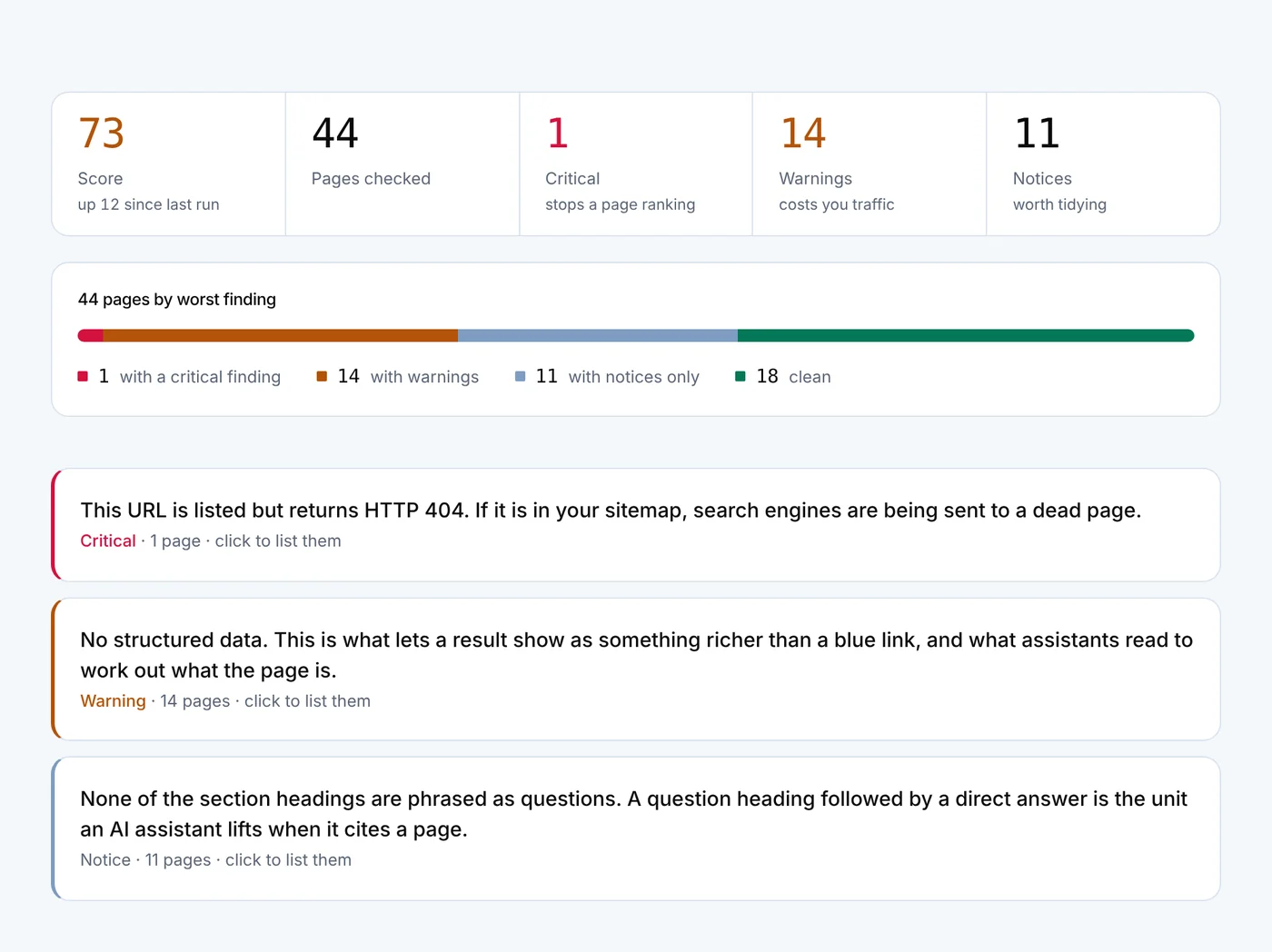
Run the free audit and see what your site needs before you pay anyone.
Start freeSide by side
| Byword | Visorank | |
|---|---|---|
| Entry price | $99 a month, 25 articles | $35 a month |
| Per article | $5, or $2.78 to $3.96 on plan credits | No per-article charge |
| Higher tiers | $299, $999 and $1,999 a month | $59 and $79 |
| API access | From the $299 tier | Publishing endpoint on every tier |
| Free option | 5 articles once at signup | Free tier |
| Bulk batches | Stable 50+ article batches | One at a time on a schedule |
| Built for | Content teams and agencies | One person running their own sites |
| Programmatic sets | Yes | Yes, with a duplicate guard |
| AI visibility tracking | Not built in; separate tool | Scored before you publish |
| Site audit | Not stated | Included |
Competitor figures collected October 2026 from published listings, not from using the product. Check their own pricing page before deciding on this basis.
What this category charges
Most of it converges on $99 a month, and nothing about the products explains why.
A note on where these figures came from
The Byword pricing above is from a comparison page published by a competing product, which checked it against Byword's own site in October 2026. That is a reasonable source for a number and a poor source for a judgement, so this page uses it only for the figures and makes no claim about how Byword performs.
Verify the current pricing on Byword's own site before deciding on that basis. Prices in this category change several times a year and a comparison page is only as trustworthy as its most out-of-date number.
When Byword is the better choice
If you are an agency or a content team rather than one person. Byword positions itself at teams and agencies, its plan sizes reflect that, and the $299 tier with API access is built for running many sites programmatically.
If you need API access as the primary way you use it. Visorank has an API path through the publishing endpoint, but the product is built around its dashboard, and a team wanting to drive everything from their own system will find Byword's shape closer to what they want.
If 25 articles a month is the volume you actually need and you will use it. At that volume the per-article cost is the number to compare, not the monthly floor.
What Visorank will not do
It is not built for agencies running dozens of client sites. Team seats and white labelling do not exist yet.
Its API surface is smaller. The product is built around the dashboard.
It will not get pages into Google faster. IndexNow covers Bing, Yandex, Seznam and Naver, and Google does not participate.
It will not rank a brand new site in a month.
On a comparison this close, test both on your own keywords.
Start freeQuestions worth asking first
Is this just a cheaper Byword?
On the core publishing loop the two are close enough that the honest answer is mostly yes, at a lower floor. The differences that are not price are the built-in AI citation scoring, the site audit, and the Reddit discovery. Whether those matter to you is a real question rather than a rhetorical one.
What happens to articles already published through Byword?
They stay on your site. Neither product hosts your content; both publish into your CMS. Switching changes who writes the next article, not what happened to the last one.
Do you support programmatic page sets like Byword does?
Yes, with per-row research rather than one template filled with variables, and with a guard that halts the run after three consecutive near-duplicates. That produces fewer pages than an unguarded generator and it is the intended behaviour.