Massblogger publishes at volume. It has no keyword research, which is the part that decides whether volume helps
High-volume publishing with nothing deciding what to publish about is how a site ends up with three hundred pages and no traffic. Their listing is upfront that keyword research and SEO analysis are not built in, which is honest and is also the thing to think hardest about.
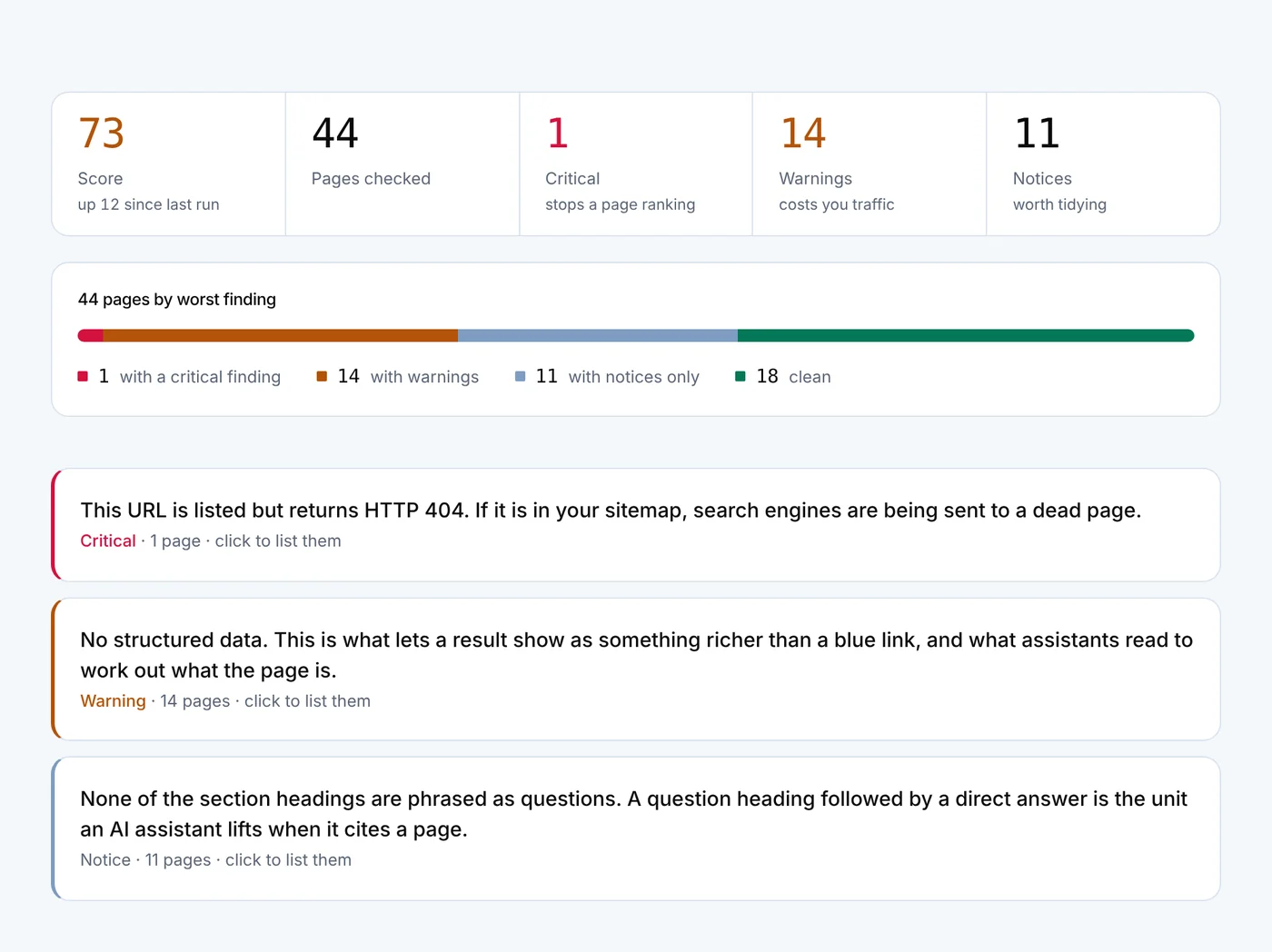
Volume is downstream of knowing what to write
Massblogger has a free plan, $59 a month on Discovery and $99 on Pro, publishing to WordPress with programmatic SEO, as of October 2026. Its published limitations include no built-in keyword research or SEO analysis, a limited backlink network and a smaller community.
So the research has to come from somewhere else: another subscription, or your own judgement about what people search. For someone who already has a researched keyword list and wants a cheap way to publish against it, that gap is not a problem and the free plan is attractive.
For everyone else it is the whole problem. Publishing fast against guesses produces pages nobody searched for, and programmatic sets built that way are the ones that differ by one word and get treated as duplicates.
What Visorank does before writing anything
Research first, then volume, with a guard on what volume is allowed to produce.
- Keyword expansion from Google itself
- Autocomplete, related searches and People Also Ask, so the list is what people type rather than what sounds right.
- Live results analysis
- Who currently holds each position, read from the results page rather than from a stale index.
- A duplicate guard on programmatic sets
- Generation halts after three consecutive near-duplicates instead of publishing a set that differs by a place name. Fewer pages, deliberately.
- Per-row research on generated sets
- Each page in a set gets its own research pass rather than one template filled with variables.
- Rank tracking afterwards
- So volume becomes evidence instead of hope.
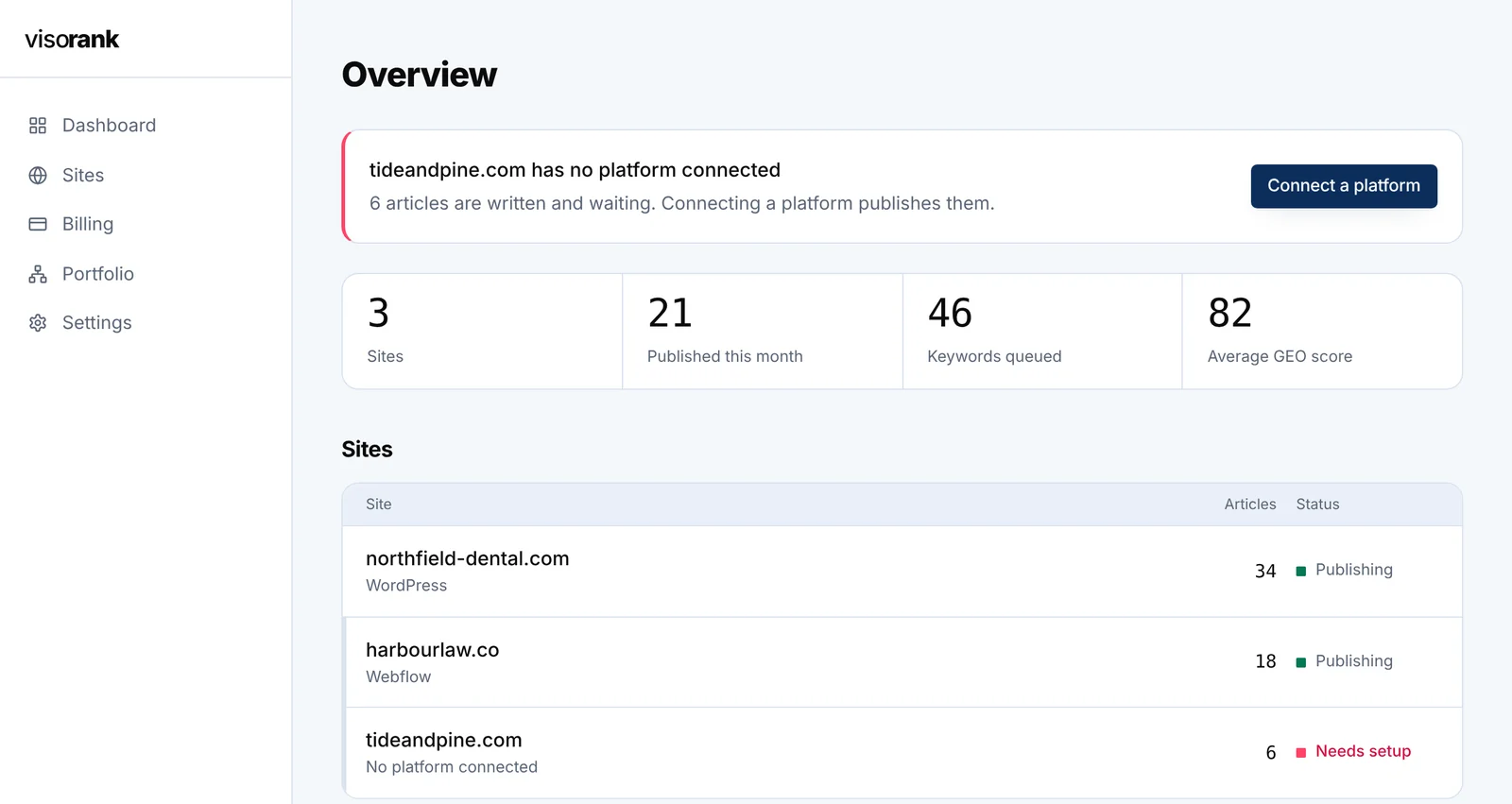
Research first, then publish. Start free and see the keyword expansion.
Start freeSide by side
| Massblogger | Visorank | |
|---|---|---|
| Free plan | Yes | Free tier |
| Entry paid price | $59 a month | $35 a month |
| Top tier | $99 a month | $79 a month |
| Keyword research | Not built in | Included, from Google's own surfaces |
| SEO analysis | Not built in | Site audit plus live results analysis |
| Publishing volume | High volume is the design | One at a time on a schedule |
| Programmatic SEO | Yes | Yes, with a duplicate guard and per-row research |
| Publishing targets | WordPress | WordPress, Shopify, Ghost, Webflow, custom endpoint |
| Backlink network | Limited | None, by choice |
| Rank tracking | Not stated | Included |
Competitor figures collected October 2026 from published listings, not from using the product. Check their own pricing page before deciding on this basis.
What this category charges
Most of it converges on $99 a month, and nothing about the products explains why.
About the backlinks they include
Several products in this category bundle backlinks: a pool of other customers' sites that link to your articles, usually metered as credits. It is the most attractive line on their pricing page, because links are the thing nobody can easily buy and everybody wants.
It is also a link exchange. Google's link spam policy names excessive link exchanges directly, alongside buying links and automatically generated links. A vendor-run pool where customers link to each other to pass authority is that arrangement with a billing page attached, whatever the marketing calls it.
The part worth sitting with: the risk does not land on the vendor. It lands on your domain. If Google devalues the pattern or issues a manual action, your rankings take it, the vendor keeps billing, and you cannot unpick which of your links came from where. Plenty of these networks run for years without visible consequence, so this is a risk rather than a certainty. But it is your site that carries it.
Visorank does not build links and will not. That costs us a line on this page that would sell well, and it is the reason the rest of this page can be straight with you.
Where Massblogger is the better buy
If you already have a researched keyword list and want the cheapest way to publish against it, their free plan is hard to argue with.
If raw publishing volume is the goal, that is what they are built for and Visorank deliberately produces less.
Visorank has no agency tier, no team seats and no white labelling.
Neither product gets pages into Google faster than Google wants them.
Run the free audit before adding anything to your site.
Start freeQuestions worth asking first
Is high-volume publishing still safe?
Google's spam policies name scaled content abuse: mass-produced pages made primarily to rank rather than to help. Volume alone is not the trigger; volume of near-identical thin pages is. That is why the duplicate guard here stops a run rather than filling a site.
Can I bring my own keyword list?
Yes, on both. If you have one, the research gap in their product matters much less and the comparison comes down to platforms and price.
Why would a tool produce fewer pages on purpose?
Because the marginal page in a near-duplicate set has negative value: it competes with its siblings and dilutes the set. Three hundred pages that each own nothing lose to thirty that each own a question.