RankYak prices per site. That is the whole decision if you run more than one
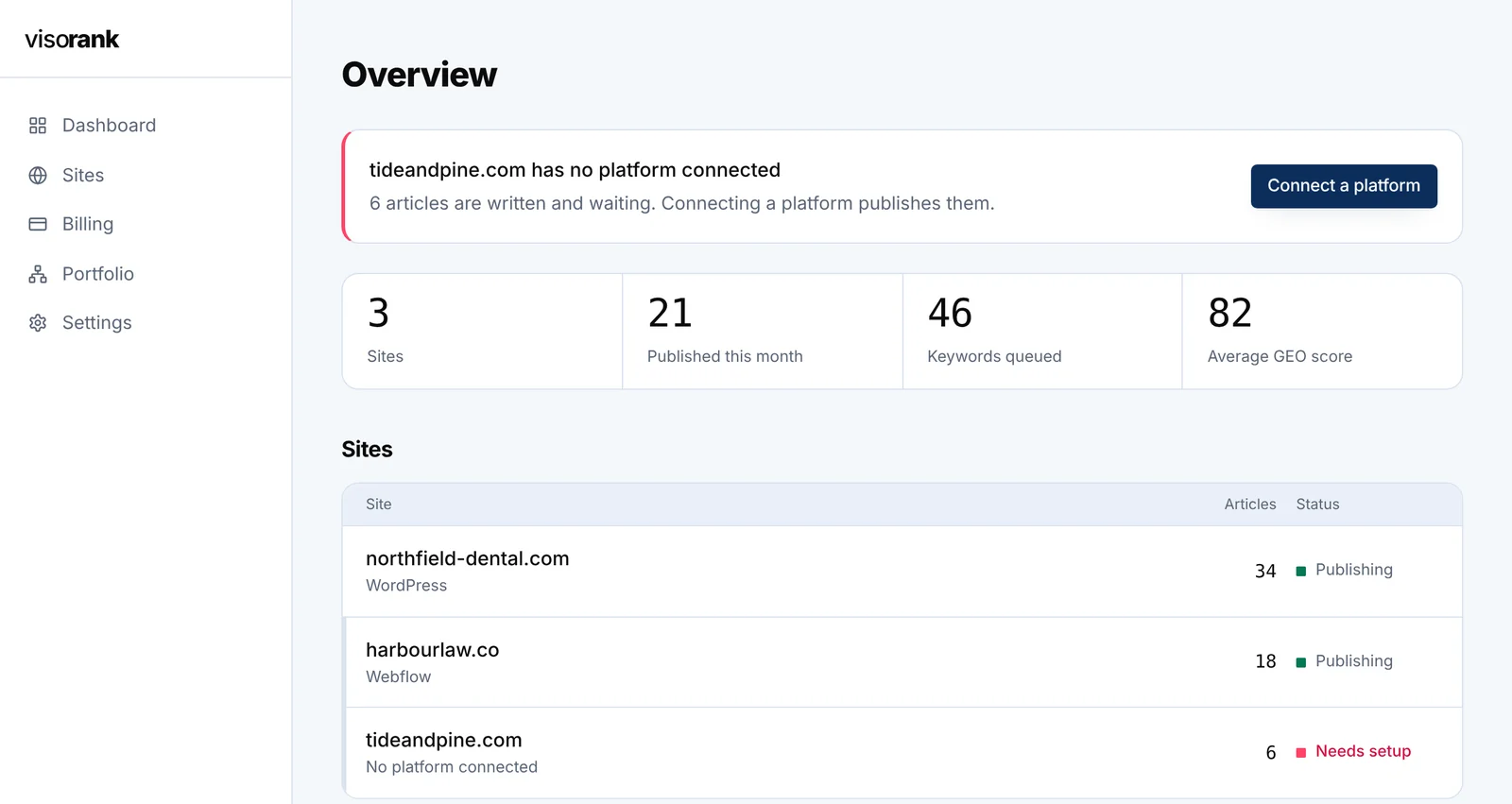
RankYak is $99 per site per month, or $990 a year per site, with multi-site discounts up to 20%. Three sites is roughly $237 a month after the best discount. The same three sites on Visorank is $79. If you run one site the gap is smaller and the rest of this page matters more.
What per-site pricing does to a portfolio
Most people who want automated publishing do not have one site. They have a main business, a side project, and something they are testing. Per-site pricing is built for the first of those and punishes the other two, which is how a tool that looked affordable becomes the largest line in a small software budget.
The other thing worth checking before you buy either product: RankYak writes and publishes daily, with less editorial control before publishing, and it maintains existing pages. If you want articles going live without you reading them, that is the feature. If the thought makes you uneasy, that is the thing to look at rather than the price.
What Visorank does differently
Everything below is in the product rather than a separate subscription, which is most of why the price difference does not mean fewer capabilities.
- Drafts wait for you
- Nothing publishes until you approve it, unless you deliberately turn that off. The default is the opposite of publish-and-hope.
- Four publishing targets plus your own endpoint
- WordPress, Shopify, Ghost and Webflow, filed under the right category rather than dropped in Uncategorised.
- The site you already have gets audited
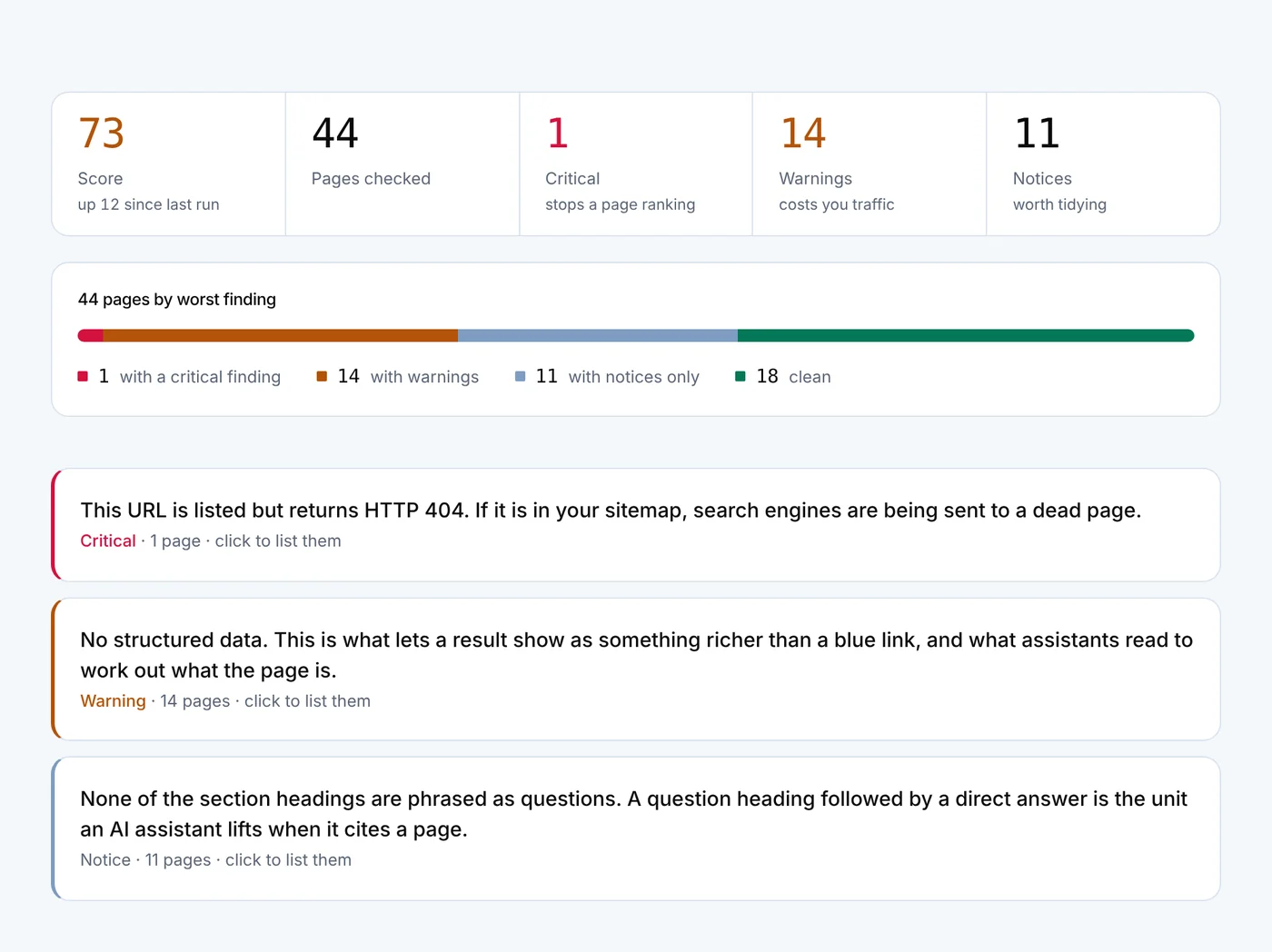
- A crawl reporting pages blocked from indexing, missing titles, duplicates and absent structured data. On most sites this is worth more than the next ten articles.
- Drafts are scored for AI citation before publishing
- Whether an assistant can lift an answer out of the page: direct answer up front, question-shaped headings, facts attached to entities.
- No link building, deliberately
- RankYak includes automated backlinks. The section below explains at length why we do not, and it is the most important thing on this page.
Run the free audit and see what your site is already getting wrong.
Start freeSide by side
| RankYak | Visorank | |
|---|---|---|
| Entry price | $99 per site, per month | $35 a month |
| Three sites | About $237 after multi-site discount | $79 on the Scale tier |
| Annual option | $990 per site per year | Monthly only |
| Agency plan | $99 per client, first client free | No agency tier yet |
| Backlinks | Automated backlinks included | None, by choice |
| Publishing targets | WordPress | WordPress, Shopify, Ghost, Webflow, custom endpoint |
| Editorial control | Less control before publishing | Drafts wait for approval by default |
| Site audit | Not stated | Included |
| AI citation scoring | Not stated | Scored before you publish |
| Payment | Card | Card, mobile money, USSD |
Competitor pricing collected October 2026 from published listings, not from using the product. Check their own pricing page before deciding on this basis.
What this category charges
Most of it converges on $99 a month, and nothing about the products explains why.
About the backlinks they include
Several products in this category bundle backlinks: a pool of other customers' sites that link to your articles, usually metered as credits. It is the most attractive line on their pricing page, because links are the thing nobody can easily buy and everybody wants.
It is also a link exchange. Google's link spam policy names excessive link exchanges directly, alongside buying links and automatically generated links. A vendor-run pool where customers link to each other to pass authority is that arrangement with a billing page attached, whatever it is called in the marketing.
The part worth sitting with: the risk does not land on the vendor. It lands on your domain. If Google devalues the pattern or issues a manual action, your rankings take it, the vendor keeps billing, and you cannot unpick which of your links came from where. Plenty of these networks have run for years without visible consequence, so this is a risk rather than a certainty. But it is your site that carries it.
Visorank does not build links and will not. That costs us a line on this page that would sell well, and it is the reason we can say the rest of this page is straight.
Where RankYak is the better buy
If you want an annual plan. RankYak offers $990 a year per site and Visorank bills monthly only, which is worse for anyone who prefers to pay once and forget it.
If you are an agency. Their $99 per client with the first free is built for that and Visorank has no agency tier, no team seats and no white labelling.
If you genuinely want daily publishing with no review step, and you have the tolerance for what occasionally goes out.
Neither product can get pages into Google faster than Google wants them. IndexNow reaches Bing, Yandex, Seznam and Naver, and Google does not participate.
One account, every site. Start on the free tier and compare on your own keywords.
Start freeQuestions worth asking first
Is the cheaper option worse?
On this comparison the price gap is mostly pricing model rather than capability: per-site against per-account. Where RankYak is ahead is the annual option and the agency plan, both named above. Where it is behind is platform coverage and editorial control. Judge it on those rather than on the number.
Can I move sites across without losing articles?
Yes. Neither product hosts your content; both publish into your own CMS. Published articles stay exactly where they are. What you set up again is the keyword list and the schedule.
What happens to the backlinks if I stop using a tool that built them?
They generally stay until the sites hosting them change or disappear, which is partly the problem: you inherit a link profile you did not choose and cannot fully enumerate. If you have already used a tool like this, the practical step is to export whatever link report it gives you and keep it, so you at least know what is pointing at you.