Clearpost is WordPress only. That is a feature until it is not
Clearpost publishes natively to WordPress through the REST API and nothing else. If WordPress is where you are and where you will stay, a tool built for one platform can do things a general one cannot. If there is any chance of a Shopify store or a Webflow site in your future, you are choosing a ceiling.
The thing to work out before you compare anything else
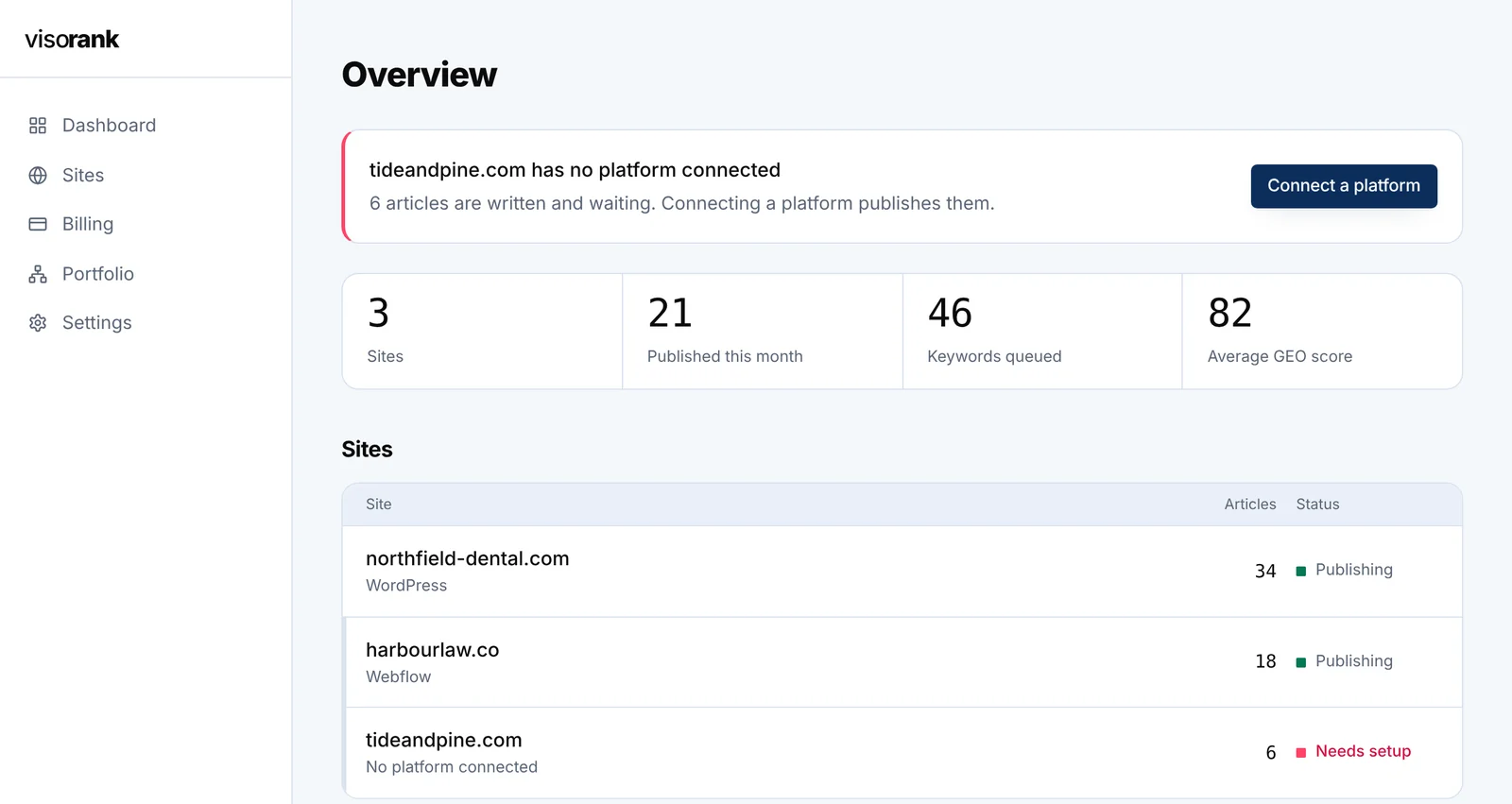
Single-platform tools make a real trade. They can lean on that platform's specifics: its REST API, its categories and taxonomies, its scheduling. The cost is that the tool ends at the platform boundary, and that boundary tends to arrive sooner than people expect. A business adds a store, launches a second brand on a different stack, or moves off WordPress entirely, and the tool does not come.
The second thing to compare is cost shape rather than cost. Clearpost has a genuinely interesting free tier where you bring your own API key, then Premium at $99 a month and Business at $199, as of October 2026. Visorank is $35, $59 or $79. The free tier is the part worth taking seriously: if you are technical and happy managing an API key, it is hard to argue with free.
What you get for the difference
If you are weighing the paid tiers rather than their free one, here is what the gap buys.
- Four platforms and a custom endpoint
- WordPress, Shopify, Ghost and Webflow, so the tool does not end where your stack changes.
- A site audit of what is already live
- Indexing problems, missing titles, duplicate content, absent structured data. The things no amount of new publishing compensates for.
- AI citation scoring on every draft
- Scored before you publish, so you can fix the page while fixing it is still cheap.
- Reddit threads already ranking for your keywords
- Found, scored for whether a reply is worth writing, and drafted. Nothing posts automatically.
- Local payment methods
- Card, mobile money and USSD. If a card is your obstacle rather than the price, that is the difference that matters.
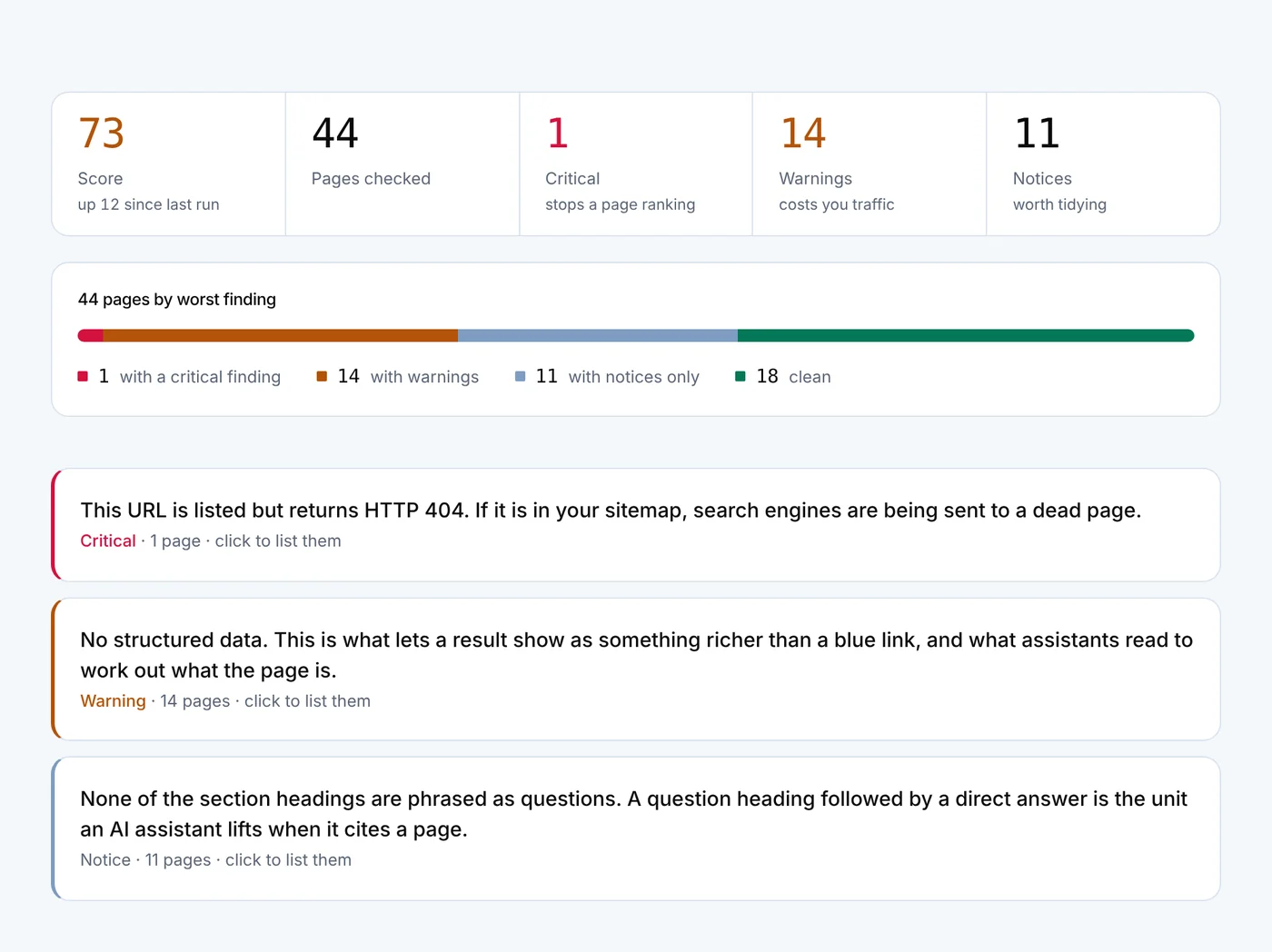
Run the free audit on your WordPress site and see what is already broken.
Start freeSide by side
| Clearpost | Visorank | |
|---|---|---|
| Entry price | Free with your own API key, then $99 | $35 a month |
| Top tier | $199 a month | $79 a month |
| Free trial | 7 days, no card required | Free tier, no card |
| Publishing targets | WordPress only, native REST API | WordPress, Shopify, Ghost, Webflow, custom endpoint |
| Keyword source | Google Search Console | Search Console, autocomplete, related searches, People Also Ask |
| Approval queue | Yes | Yes, drafts wait by default |
| Content calendar | Yes | Yes, with a forward projection of when the queue runs dry |
| Site audit | Not stated | Included |
| AI citation scoring | Not stated | Scored before you publish |
| Languages | Fewer language options | Per site, any language |
Competitor pricing collected October 2026 from published listings, not from using the product. Check their own pricing page before deciding on this basis.
What this category charges
Most of it converges on $99 a month, and nothing about the products explains why.
Where Clearpost is the better buy
If you are on WordPress, staying on WordPress, and technical enough to bring your own API key, their free tier is cheaper than anything here and that is not a close call.
A tool built for one platform can handle that platform's edges more thoroughly than a general one. If you depend on specific WordPress taxonomies or plugin behaviour, test both against your actual site.
Visorank has no agency tier, no team seats and no white labelling, whoever you are comparing it against.
Neither gets pages into Google faster. IndexNow covers Bing, Yandex, Seznam and Naver; Google is not a participant.
If a second platform is anywhere in your plans, test against it now rather than later.
Start freeQuestions worth asking first
Is a bring-your-own-key free tier actually cheaper?
Usually yes, and it is worth doing the arithmetic rather than assuming. You pay the model provider directly, which for a few articles a month is typically a few dollars. What you take on is the key management, the billing relationship and the debugging when a model call fails. If that sounds fine, it is the cheapest route in this comparison.
Can I use Visorank with WordPress specifically?
Yes, it is the most used target. Articles publish through the REST API with the category set, rather than everything landing in Uncategorised, which is the failure people notice in month two.
What if I move off WordPress later?
That is the scenario this page is really about. Published articles stay on the old site either way; what changes is whether your tool follows you. A single-platform tool does not.