Getting cited by ChatGPT is mostly a formatting problem
That sounds reductive and it is close to literally true. An assistant answering a question is looking for a passage it can lift and attribute. Most pages do not contain one, not because the writing is bad but because the answer is on paragraph six behind a warm-up nobody asked for.
Why good pages get passed over
The standard shape of a web article was built for a reader who scrolls and for a search engine that reads the whole document. It opens by establishing the topic, explains why the topic matters, and arrives at the answer somewhere in the middle. That shape works for both of those audiences and fails completely for the third one.
An assistant assembling an answer needs a passage that stands alone: it has to make sense lifted out of your page and dropped into a reply, with your name attached. If your answer only makes sense after three paragraphs of context, there is nothing to lift, and a thinner page that stated its answer plainly gets the citation instead.
This is why the advice to write better content does not help. The page may already be better. It is shaped wrong.
What to change, in order
All four of these are measurable, which is the point: you can check a page rather than wonder about it.
- Move the answer to the opening
- The first paragraph should answer the question in the title, directly, before any context. Everything you were going to say first can go second.
- Phrase headings as questions
- Not 'Pricing' but 'How much does it cost'. The heading is what an assistant matches a user's question against.
- Put the answer immediately under the question
- No preamble between a question heading and its answer. This one is a formatting habit rather than a writing skill, and it is the one most often broken.
- Attach checkable facts
- Numbers, dates, named things. A passage with nothing specific in it is a passage with no reason to be quoted over anyone else's.
- Then score it rather than guessing
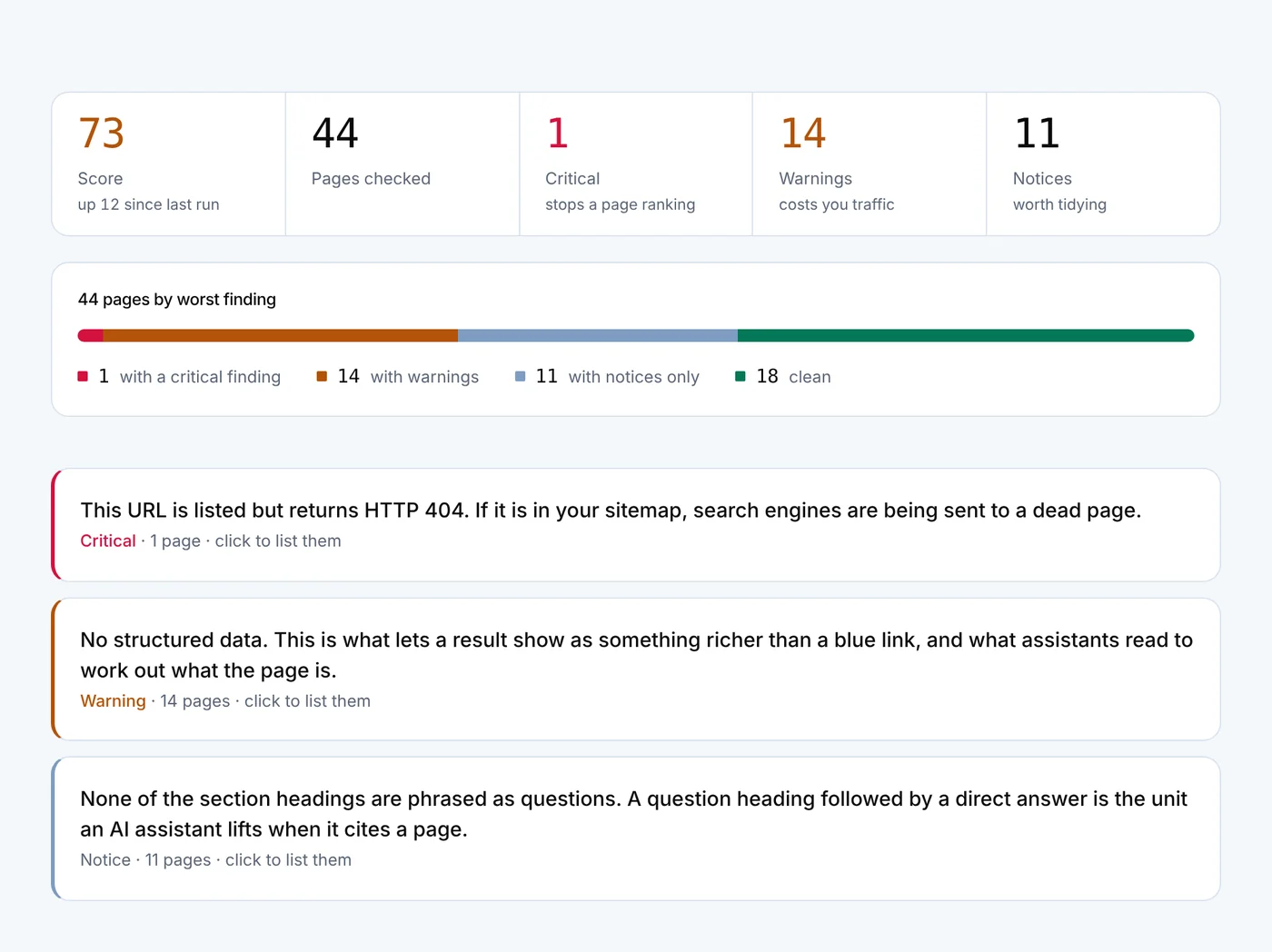
- The free GEO checker takes a page and returns a score per signal with reasons. No account, no card.
Score a page free and see which of the four signals it fails.
Score a page freeThe four things the scorer measures, and why those four
An assistant answering a question does not read your page the way a person does. It is looking for a passage it can lift and attribute. Four properties decide whether your page contains such a passage, and all four are structural rather than stylistic, which is why they can be measured rather than judged.
A direct answer in the opening. If the first paragraph restates the question, sets context and promises an answer later, there is nothing to lift from it. The answer has to be in the first hundred words or so, stated plainly, before the caveats.
Headings phrased as questions. An assistant matching a user's question against your page matches most readily against a heading that is itself that question. Our own audit of langoli.com found thirty-three pages with not one question-phrased heading on them, which is typical rather than unusual.
Answers sitting directly under their questions. A question heading followed by two paragraphs of preamble breaks the pairing. The answer has to be the first thing under the heading, which is a formatting discipline more than a writing one.
Specific facts a reader could check. Numbers, dates, named entities, concrete claims. A page of general advice has nothing to quote; a page stating that the llms.txt v2 spec is dated 10 August 2026 does. This is the signal that filler content fails hardest: scoring a filler article on this dimension took its score from 74 to 45 once the measure was corrected.
What nobody can tell you, including us
Whether a given change will get you cited. Assistants do not publish their retrieval criteria, those criteria change, and the same question asked twice can produce different sources. Anyone selling you a guaranteed method for citation is selling something they cannot deliver.
What is knowable is whether your page contains a liftable passage at all. That is a property of your document, it does not depend on anyone's undisclosed ranking, and it is the thing within your control. A page that scores well may still not be cited. A page that scores badly almost certainly will not be, because there is nothing in it to cite.
Treat the score the way you would treat readability: a measure of whether the page is fit for a purpose, not a prediction of the outcome.
What this does not do
It does not get you into ChatGPT's index. Assistants draw on search results and their own crawls, and neither is something a page can opt into.
It does not replace ranking. Pages that assistants cite tend to be pages that already rank, so this is work on top of SEO rather than instead of it.
It cannot measure whether you are currently being cited. That needs polling the assistants, which this product does not do.
Scoring well is not a promise of citation, for the reasons above.
Every draft Visorank writes is scored on these four before it publishes.
Score a page freeQuestions worth asking first
Does ChatGPT read my site directly?
It draws on a mix of its training data, live search results, and its own crawler for sites that permit it. Which of those supplies any given answer is not disclosed per response, which is why no tool can tell you with certainty why you were or were not cited.
Should I add an llms.txt file?
It costs nothing and probably does nothing. Google's own documentation states that Google Search ignores llms.txt files and that they neither help nor harm rankings, and no AI provider has publicly confirmed that its crawler fetches llms.txt from other people's domains. The v2 spec is dated 10 August 2026 and remains a community proposal rather than a standard. If you want one anyway, there is a free generator here.
Do I need structured data for this?
It helps a search engine understand the page and it is worth having, but the citation decision appears to hinge on whether the prose contains a liftable answer. Schema on a page whose answer is buried does not surface the answer.