You can measure whether assistants cite you with a spreadsheet and an hour a month
Products exist that poll assistants and chart your mentions, and some are good. Before paying for one it is worth knowing that the underlying method is asking questions and writing down the answers, that you can do it, and that doing it yourself teaches you things a chart does not.
Two different questions people conflate
Am I being cited, and is my page worth citing. These sound like the same question and they have different answers, different methods and different costs.
The first is an outcome. Measuring it means asking assistants real questions and recording which sources they name. It cannot be derived from your page; it has to be observed, repeatedly, because answers vary between sessions and over time.
The second is a property of your document: does it contain a passage an assistant could lift and attribute. That is measurable from the page alone, instantly and for free, and it is the only one of the two you can act on before publishing.
Most tools sell the first and imply it tells you how to fix things. It does not. It tells you where you stand.
The method, in full
This is what the paid products automate. Done by hand it costs an hour a month and no money.
- Write ten real questions
- The ones customers ask before buying, in their words. Not your keywords. Ten is enough to see a pattern and few enough to repeat monthly.
- Ask each assistant you care about
- ChatGPT, Perplexity, Claude, Google AI Mode. Use a fresh session each time so prior context does not shape the answer.
- Record the domains cited, not the sentiment
- One row per question per assistant, with the sources named. Sentiment is noise at this sample size; the citation list is the signal.
- Repeat monthly, same questions
- The value is entirely in the trend. A single month tells you almost nothing because answers vary between sessions.
- Score the pages that lost
- Where a competitor was cited and you were not, run their page and yours through the free GEO checker. The difference is usually structural and visible.
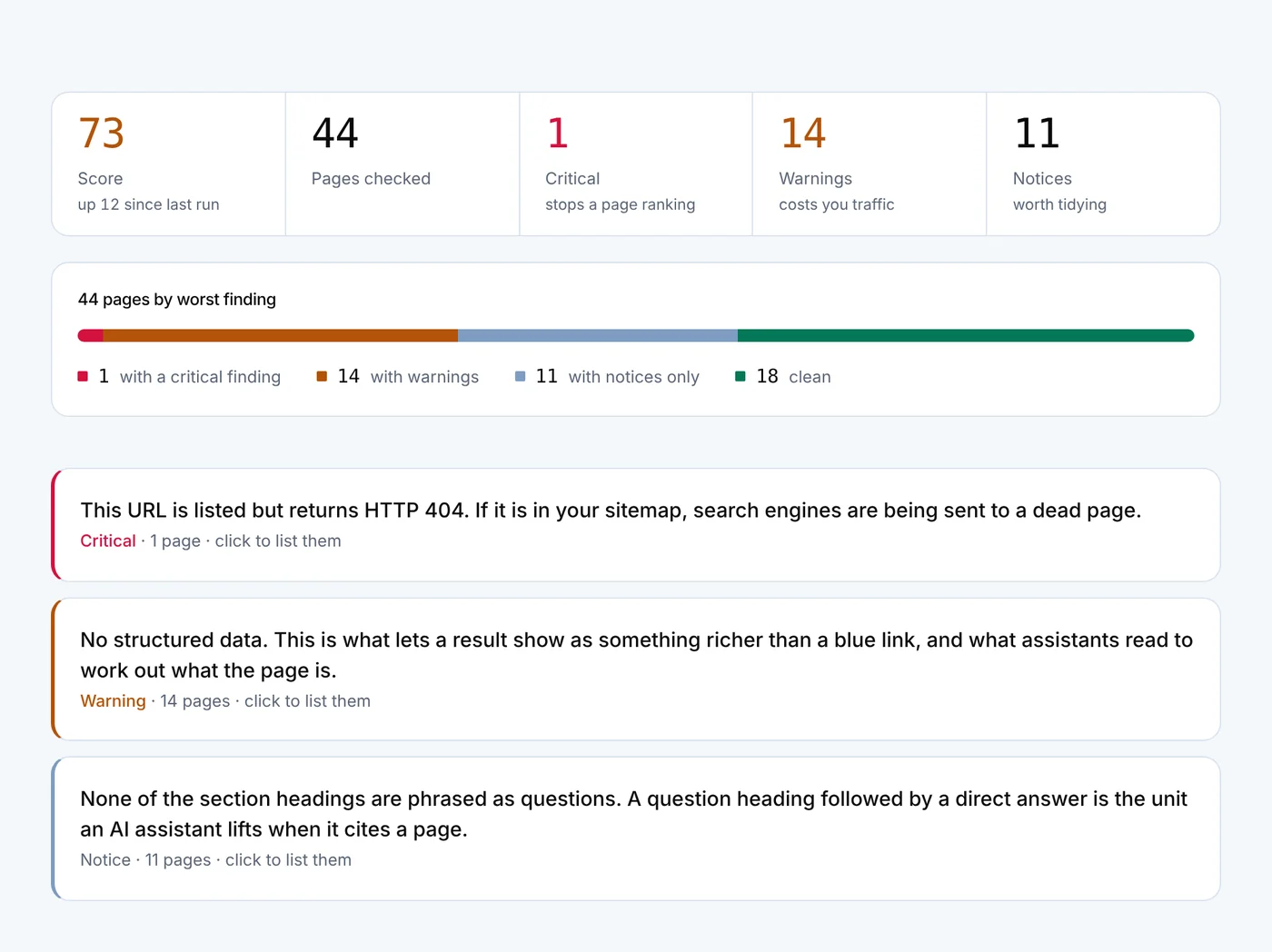
Score your page and a competitor's side by side, free.
Score a page freeWhat the numbers do and do not mean
A citation rate from ten questions across four assistants is a sample of forty observations, which is small. Treat a change from three mentions to five as noise. Treat a change from one to eight, sustained across two months, as real.
Variance between sessions is genuinely large. The same question asked twice in a day can cite different sources. This is why a single check tells you nothing and why any product showing you a precise percentage from a single run is showing you more confidence than the underlying data supports.
The useful output is not your own number. It is the list of domains that keep appearing. Those are the pages the assistants trust on your topic, they are readable, and comparing them against yours is the most direct feedback available on this whole subject.
The four things the scorer measures, and why those four
An assistant answering a question does not read your page the way a person does. It is looking for a passage it can lift and attribute. Four properties decide whether your page contains such a passage, and all four are structural rather than stylistic, which is why they can be measured rather than judged.
A direct answer in the opening. If the first paragraph restates the question, sets context and promises an answer later, there is nothing to lift from it. The answer has to be in the first hundred words or so, stated plainly, before the caveats.
Headings phrased as questions. An assistant matching a user's question against your page matches most readily against a heading that is itself that question. Our own audit of langoli.com found thirty-three pages with not one question-phrased heading on them, which is typical rather than unusual.
Answers sitting directly under their questions. A question heading followed by two paragraphs of preamble breaks the pairing. The answer has to be the first thing under the heading, which is a formatting discipline more than a writing one.
Specific facts a reader could check. Numbers, dates, named entities, concrete claims. A page of general advice has nothing to quote; a page stating that the llms.txt v2 spec is dated 10 August 2026 does. This is the signal that filler content fails hardest: scoring a filler article on this dimension took its score from 74 to 45 once the measure was corrected.
What this product does and does not measure
It scores pages for whether they are quotable, before publishing, on four structural signals. That is the half you can act on.
It does not poll assistants and does not track mentions over time. If you want that automated, buy a product that does it, and ask how many samples sit behind each number.
A score is not a prediction. A well-structured page may not be cited; a badly structured one almost certainly will not be.
Nothing here measures sentiment, which at these sample sizes is not measurable anyway.
Ten questions, four assistants, once a month. That is the whole method.
Score a page freeQuestions worth asking first
Is a paid AI visibility tracker worth it?
It depends on whether you would act on the output. If the answer is a monthly chart you glance at, the spreadsheet is free and teaches you more. If you are running many sites or reporting to someone, automation earns its cost. Ask any vendor how many samples per data point; the honest ones will tell you.
Why do answers vary so much between sessions?
Assistants sample when generating, retrieval differs per session, and live search results change underneath. That variance is inherent rather than a flaw, and it is why trend over months beats precision in any single month.
What do I do with the competitor list?
Read the pages. They are the ones assistants are choosing on your topic and they are sitting in the open. Run them through the free checker beside your own and the structural difference is usually plain within a minute.