Perplexity is the answer engine that still sends you traffic
It cites inline, numbered, next to the claim, and people follow those links. That makes it a different proposition from an overview that answers the question and ends the session, and it is the reason it is worth separate attention despite being the smaller audience.
Why the smaller engine may be the better target
Attention goes to the largest surfaces, which is rational and incomplete. The number that matters is not how many people use an engine but how many leave it to visit a source. An engine that answers completely and keeps the user produces visibility without visitors; one that cites inline and expects readers to verify produces both.
Perplexity's interface is built around the second behaviour. Claims carry numbered sources placed next to them, and the product's whole premise is that you can check it. Readers do.
The practical consequence: a page that is cited by Perplexity is read, not merely named. For a small site deciding where to spend limited effort, that ratio matters more than audience size.
What it rewards
Largely the same four structural properties as every other answer engine, with specificity mattering more than elsewhere.
- A passage that stands alone
- Inline citation means a specific sentence is attached to a specific claim. The sentence has to carry the claim by itself.
- Checkable specifics above all
- An engine built around verification favours sources that state something verifiable. This is the signal to push hardest here.
- Question headings
- Same mechanism as elsewhere: the heading is what a query aligns against.
- Recency where the topic has any
- On anything that changes, a dated page stating when it was last checked gives an engine a reason to prefer it over an undated one.
- A score before you publish
- The free checker measures the first three. The fourth is a habit you adopt.
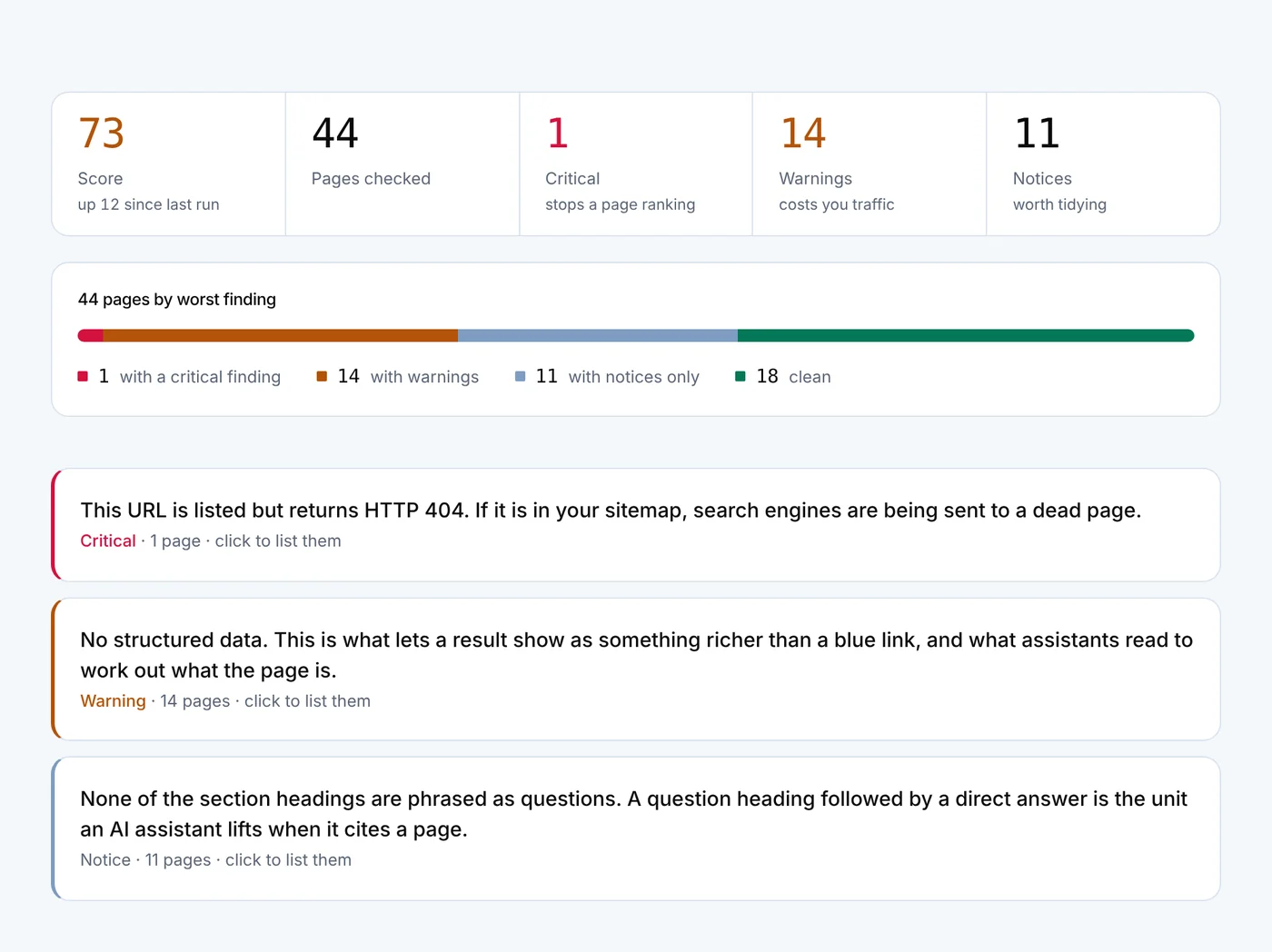
Score a page free and see what an engine can lift from it.
Score a page freeThe four things the scorer measures, and why those four
An assistant answering a question does not read your page the way a person does. It is looking for a passage it can lift and attribute. Four properties decide whether your page contains such a passage, and all four are structural rather than stylistic, which is why they can be measured rather than judged.
A direct answer in the opening. If the first paragraph restates the question, sets context and promises an answer later, there is nothing to lift from it. The answer has to be in the first hundred words or so, stated plainly, before the caveats.
Headings phrased as questions. An assistant matching a user's question against your page matches most readily against a heading that is itself that question. Our own audit of langoli.com found thirty-three pages with not one question-phrased heading on them, which is typical rather than unusual.
Answers sitting directly under their questions. A question heading followed by two paragraphs of preamble breaks the pairing. The answer has to be the first thing under the heading, which is a formatting discipline more than a writing one.
Specific facts a reader could check. Numbers, dates, named entities, concrete claims. A page of general advice has nothing to quote; a page stating that the llms.txt v2 spec is dated 10 August 2026 does. This is the signal that filler content fails hardest: scoring a filler article on this dimension took its score from 74 to 45 once the measure was corrected.
What this cannot measure, and the honest consequence
Whether Perplexity currently cites you. Finding that out means asking it your questions and reading the sources, by hand, which is tedious and is also the only reliable method available without a paid tracking product.
If you do it, do it properly: write down ten questions a customer would actually ask, ask them, and record which domains are cited. Repeat monthly. That is a spreadsheet and an hour, and it tells you more than any score, because it measures the outcome rather than the input.
The score measures whether your page is fit to be cited. The spreadsheet measures whether it is being cited. They answer different questions and the second one is the one that matters; the first one is the one you can act on before publishing.
What this will not do
It will not tell you whether Perplexity cites you today. No polling of assistants happens in this product.
It will not get you into any engine's index.
It does not replace ranking in ordinary search, which remains the larger channel by a wide margin.
Scoring well is not a promise of citation. No one can promise that and no one should offer to.
Ten questions, asked monthly, in a spreadsheet. That is the honest measurement.
Score a page freeQuestions worth asking first
Is it worth optimising for an engine with a small share?
Judge it on visitors rather than users. An engine that cites inline and expects verification sends a far higher proportion of its users onward than one that answers and ends the session. The smaller audience can be the larger referrer.
Does the work differ from Google AI Overviews?
The structural work is largely the same, which is convenient: one set of changes serves both. The emphasis differs, with checkable specifics mattering more where the interface is built around verification.
Should I block AI crawlers instead?
That is a real choice and it has a real cost: blocking a crawler removes you from the answers it produces, including the ones that would have sent you readers. Publishers with large archives and licensing leverage sometimes make that trade. A small site usually has more to gain from being quoted than from not being read.